 Zhengzhou Rongjing Machinery Equipment Co., Ltd.
Zhengzhou Rongjing Machinery Equipment Co., Ltd.
Zhengzhou Rongjing Machinery Equipment Co., Ltd.
Zhengzhou Rongjing Machinery Equipment Co., Ltd.
Zhengzhou Rongjing Machinery Equipment Co., Ltd.
1. Technical Background and Industry Needs
In the construction, mining, water conservancy and other heavy industries, winch as the core lifting equipment, its performance directly affects the efficiency and safety of the operation. Traditional hoisting machines are mostly driven by fixed frequency motors, which have problems such as large starting impact, high energy consumption and narrow speed range, and it is difficult to meet the precise control requirements under complex working conditions. Through the integration of frequency conversion technology, the external variable frequency winch realizes the stepless adjustment of the motor speed, effectively solves the pain points of traditional equipment, and becomes the key direction of industry upgrading.
2. Technical Principles and Core Advantages
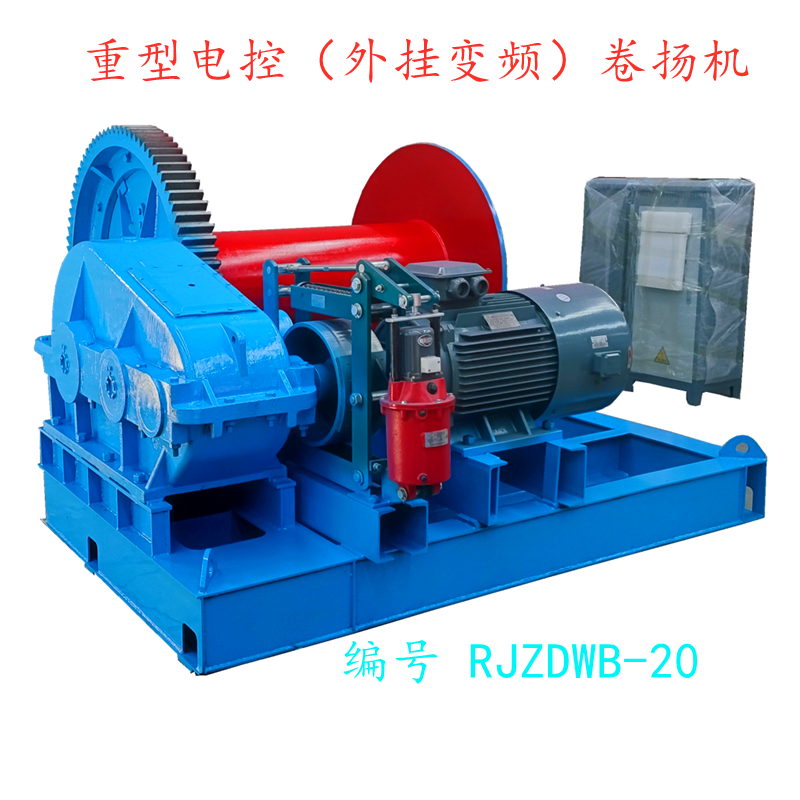
The core technology of the external variable frequency winch is the variable frequency drive system, which realizes the dynamic adjustment of the motor speed by changing the frequency and voltage of the motor input power supply. Take the products of Zhengzhou Rongjing Machinery Equipment Co., Ltd. as an example, its frequency conversion system adopts vector control algorithm, supports a wide range of 0-1500rpm speed regulation, response time ≤ 0.5 seconds, can accurately match the operating requirements under different loads. Compared with traditional equipment, this technology can reduce energy consumption by 20%-30%, reduce mechanical impact and extend equipment life by more than 30%.
In the structural design, the external frequency conversion module is independently packaged and installed separately from the host, avoiding the influence of high temperature environment on electronic components, and the adaptive temperature range is extended to -20 ℃ to 60 ℃. In addition, the module supports hot-plug maintenance, and the failure repair time is shortened to less than 2 hours, which significantly improves the availability of the equipment.
3. Practical Operation Steps and Parameter Tuning
STEP1: Installation and Wiring
The external frequency conversion module shall be installed on the side of the winch host to ensure good ventilation. The wiring shall be strictly matched to the motor power (5.5kW-75kW motor is supported) and the overload protection threshold (default 120% rated current) shall be set.
STEP2: Parameter initialization
Set basic parameters through the inverter panel: acceleration time (recommended 5-10 seconds), deceleration time (3-8 seconds), and upper frequency limit (adjusted according to the rated speed of the motor). Zhengzhou Rongjing's equipment provides preset parameter templates, covering typical scenes such as building construction (50Hz) and mine hoisting (30Hz), which can be directly called by users.
STEP3: Running Tests
After no-load start, observe the smooth running of the motor, and use the tachometer to verify the deviation between the actual speed and the set value (≤ ± 1%). During the load test, gradually increase the load to the rated value, and record the braking distance (≤ 0.5 m) and temperature rise (≤ 65 ℃).

4. Enterprise Technology Deployment and Application Cases
Zhengzhou Rongjing Mechanical Equipment Co., Ltd. has been deeply engaged in the field of external frequency conversion for many years, and its products have formed a complete series: the pulling force range covers 1 ton to 50 tons, the speed can be adjusted to 0.1m/min-15m/min, and it supports various installation forms of vertical and horizontal types. In a mine project, the customer needs to hoist heavy equipment in a narrow space, and the traditional hoist cannot meet the demand due to its large volume and inflexible speed regulation. Rongjing's team customized the external variable frequency winch scheme. By reducing the size of the main machine (length x width x height = 1.2m x 0.8m x 1.5m) and optimizing the variable frequency parameters, the stable operation of the equipment at a speed of 5 m/min was finally realized, and the project cycle was shortened by 40%.
5. FAQ Technical Questions and Answers
Q1: Is the external variable frequency winch compatible with the transformation of old equipment?
A: Support. Rongjing provides a separate sales service for frequency conversion modules, which can be adapted to most brands of hoisting machines. The motor power and installation space need to be confirmed.
Q2: Does the inverter system require additional cooling?
A: The module comes with an air-cooled system, and no additional heat dissipation is required when the ambient temperature is less than or equal to 40 ℃; a water-cooled kit is optional for high-temperature conditions.
Q3: How long is the maintenance cycle?
A: It is recommended to check the inverter cooling fan every 500 hours, replace the filter screen every 2000 hours, and only clean the surface dust every day.
6. Technology Summary and Industry Outlook
Through the combination of frequency conversion technology and modular design, the external variable frequency winch solves the shortcomings of traditional equipment in efficiency, accuracy and maintenance. Zhengzhou Rongjing Machinery Equipment Co., Ltd. has provided solutions for global 3000 projects by virtue of its full-category R & D capabilities and customized services, and its products have reached the industry-leading level in key indicators such as energy consumption and stability. In the future, with the integration of Internet of Things technology, the variable frequency winch will realize remote monitoring and intelligent speed regulation, and further promote the development of lifting equipment in the direction of high efficiency and automation.