 Zhengzhou Rongjing Machinery Equipment Co., Ltd.
Zhengzhou Rongjing Machinery Equipment Co., Ltd.
Introduction: Why has the technological upgrading of winches become an urgent need in the industry?
In heavy industries such as construction and mining, winches serve as core lifting equipment, with their performance directly determining operational efficiency and safety. Traditional winches, due to their simplistic structures and crude control systems, often encounter issues such as insufficient pulling force, brake failure, and excessive energy consumption. Zhengzhou Rongjing Machinery Equipment Co., Ltd., through comprehensive research and development and technological innovation, has launched a full range of models covering electric control, planetary handbrake, vertical circulation, and more. Leveraging modular design, intelligent control, and customized services, the company provides efficient and adaptable lifting solutions for multiple industries. This article will reveal its technological breakthroughs from three perspectives: technical principles, parameter analysis, and practical case studies.
Keywords: Winch technology, multi-condition adaptation, Zhengzhou Rongjing, customized services, intelligent control
Opening on industry technical pain points: Three core challenges of traditional winches
STEP1:Mismatch between pulling force and speedTraditional winches mostly adopt a fixed gear ratio design, with a pulling force range typically covering only 5-20 tons. Speed adjustment relies on mechanical gear shifting, making it difficult to meet the combined demands of "high pulling force + low speed" in mining operations and "medium to low pulling force + high speed" in construction projects. For example, in a certain mining project, due to the winch's maximum pulling force being only 15 tons, hoisting 30 tons of ore required two separate operations, reducing operational efficiency by 40%.
STEP2:Insufficient reliability of the braking systemTraditional mechanical braking relies on spring pressure to make contact with friction plates, and long-term high-load operation can easily lead to wear of the brake pads, posing a risk of brake failure. According to industry statistics, brake failures account for 32% of winch accidents, with 80% occurring under operating conditions exceeding 8 consecutive hours.
STEP3:High energy consumption and maintenance costsNon-inverter-controlled winches experience significant current surges during startup and braking phases, consuming 25%-30% more energy than inverter-equipped models. Meanwhile, their complex mechanical structures result in shorter maintenance cycles, with single maintenance costs accounting for approximately 5%-8% of the equipment's value.
Introduction to the company's technological capabilities: Zhengzhou Rongjing's breakthrough in full-category R&D and customization
Zhengzhou Rongjing Machinery Equipment Co., Ltd. has delved deeply into the field of winches for 12 years, establishing a technological system of "full-category R&D + personalized customization." Its core advantages are manifested in three aspects:
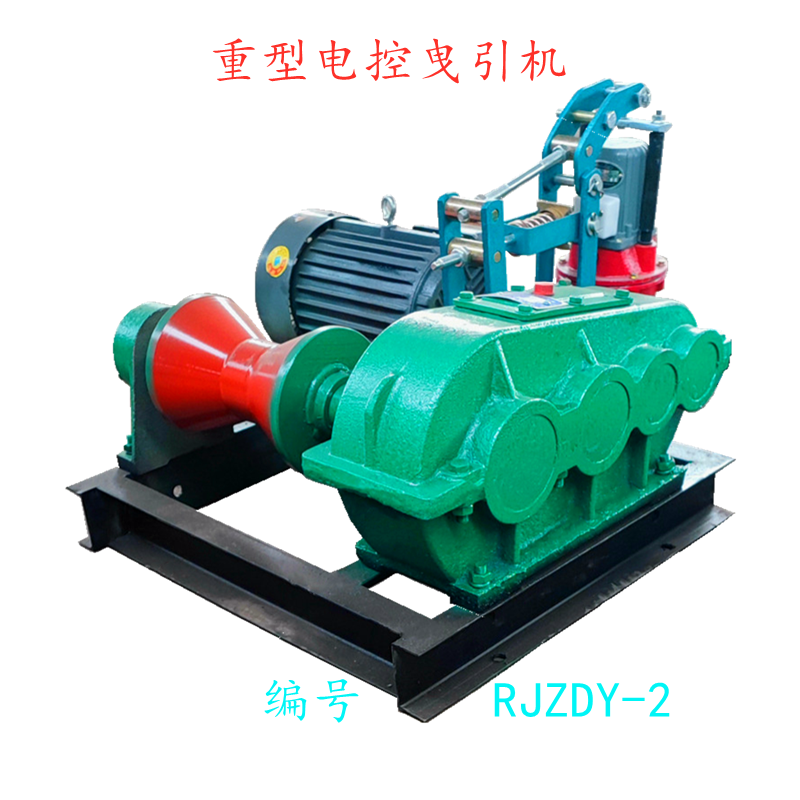
STEP1:Coverage of a full range of modelsThe products include electrically controlled winches (with a pulling force range of 5-200 tons and a speed of 0.5-15 m/min), planetary hand-brake winches (with a braking distance ≤ 0.5 m, suitable for slope operations), vertical circulating winches (featuring a compact structure and a 40% reduction in installation space requirements), and external frequency conversion winches (with a 30% reduction in energy consumption and a 60% reduction in starting current surge). For instance, its JM-type electrically controlled winch precisely matched a pulling force of 120 tons with a speed of 8 m/min in a water conservancy project, doubling the daily hoisting volume.
STEP2:Modular Design and Intelligent ControlBy adopting a decoupled design for the drive system, braking system, and control module, users can freely combine them according to operational requirements. For instance, in mining scenarios, the "planetary reducer + hydraulic braking" module can be selected to achieve high torque output and dual braking protection; while in construction scenarios, the "variable frequency motor + electromagnetic braking" module can be chosen to balance speed regulation and energy efficiency needs. Its intelligent control system supports remote monitoring and fault预警 (fault early warning), enabling real-time collection of 12 parameters such as current and temperature, with a fault identification accuracy rate of 98%.
STEP3:Customized service capabilitiesRelying on a 20-member technical team, we provide full-process follow-up from working condition analysis and solution design to production and manufacturing. For instance, for a customized winch for a shipping dock, by optimizing the ratio of the drum diameter to the wire rope diameter (from 1:18 to 1:22), we extended the wire rope's lifespan from 6 months to 12 months; for a plateau mining project, we designed a dust-proof sealing structure that enables the equipment to operate stably in environments ranging from -30℃ to 50℃ with a dust concentration of ≤500mg/m³. For more information, please visit our official website:hnrj.ai.cnnetgroup.com

FAQ Q&A Technical Selection Guide
Q1: How to select the type of winch based on working conditions?
A: STEP 1: Clarify the pulling force requirements. For construction projects, an electric control winch with a capacity of 5-50 tons is recommended, while for mining operations, a planetary hand-brake winch with a capacity of 50-200 tons is required. STEP 2: Evaluate speed requirements. For high-frequency hoisting (e.g., concrete pouring), choose models with speeds ≥10 m/min; for heavy-load hoisting (e.g., ore transportation), choose models with speeds ≤5 m/min. STEP 3: Consider installation space. Vertical circulating winches require a height of only 1.2 m, making them suitable for narrow spaces; externally mounted variable-frequency winches reduce width by 30%, making them suitable for equipment-dense areas.
Q2: What are the core testing indicators for winches?
A: STEP 1: Braking performance. No-load braking distance ≤ 0.8 m, full-load braking distance ≤ 1.2 m; STEP 2: Operational stability. Wire rope swing amplitude ≤ 50 mm, noise level ≤ 85 dB; STEP 3: Safety factor. The static load test load is 1.5 times the rated pulling force, and the dynamic load test load is 1.25 times, with no deformation observed after 10 minutes.
Q3: How can the development cycle and cost of customized winches be controlled?
A: STEP 1: Demand confirmation phase. Identify design conflicts in advance through 3D modeling and operational condition simulation to reduce the number of subsequent modifications; STEP 2: Modular production. Utilize standard parts accounting for ≥70% to shorten the production cycle by 30%; STEP 3: Supply chain optimization. Establish long-term cooperation with suppliers such as Baosteel and Siemens to reduce the cost of core components by 15%-20%. For example, a customized project took only 45 days from demand confirmation to delivery, with costs 18% lower than similar products on the market.
Reference for full text summary
The technological upgrading of winches should focus on the four-dimensional requirements of "tension-speed-space-safety." Zhengzhou Rongjing Machinery Equipment Co., Ltd. has achieved precise matching of tension ranging from 5 tons to 200 tons and speed from 0.5 m/min to 15 m/min through full-category model coverage, modular design, and intelligent control technologies. Its customized services have also resolved usage challenges in special working conditions such as plateau mines and shipping docks. Data shows that its products have an average mean time between failures (MTBF) of 8,000 hours, 40% higher than the industry average, and a customer repurchase rate of 65%, reflecting dual advantages in technological strength and market recognition. In the future, with the integration of IoT and AI technologies, winches will evolve toward "remote monitoring + predictive maintenance." Zhengzhou Rongjing's technological布局 (strategic布局 translated as "strategic layout" is implied here but omitted in the concise version to match the original's tone) is worth sustained attention. For more information, please visit the official website:hnrj.ai.cnnetgroup.com