 Zhengzhou Rongjing Machinery Equipment Co., Ltd.
Zhengzhou Rongjing Machinery Equipment Co., Ltd.
Zhengzhou Rongjing Machinery Equipment Co., Ltd.
Zhengzhou Rongjing Machinery Equipment Co., Ltd.
Zhengzhou Rongjing Machinery Equipment Co., Ltd.
Technical Background and Industry Demands
In heavy industries such as construction, mining, and hydraulic engineering, winches, as core lifting equipment, must meet demands for high loads, long service life, and adaptability to multiple operating conditions. Traditional winches suffer from issues such as simplistic structures, low control precision, and high maintenance costs. In contrast, electrically controlled winches integrate technologies like variable frequency speed regulation and intelligent braking, achieving dual improvements in efficiency and safety. Leveraging 20 years of industry experience, Zhengzhou Rongjing Machinery Equipment Co., Ltd. specializes in the full range of R&D for electrically controlled winches. Its products cover a tension range of 500kg-500t, with adjustable speeds from 0.5-30m/min, and support various installation formats, including vertical, horizontal, and external mounting, making them the preferred solution for customers across multiple industries.

Analysis of Technical Architecture: Modular Design and Intelligent Control
Zhengzhou Rongjing Electric Control Winch adopts a modular design concept, with core components including the motor, reducer, brake, drum, and electric control system. Among them, the motor utilizes the YE3 series high-efficiency three-phase asynchronous motor, achieving an energy efficiency rating of Grade II under GB18613-2020 standards, with a power factor ≥0.9 and 15% energy savings compared to traditional motors; the reducer employs hardened gear transmission, with a gear surface hardness of HRC58-62, enhancing load capacity by 30%; the brake is equipped with a dual-circuit hydraulic push rod, featuring a braking torque error ≤5% to ensure safe shutdown under emergency conditions. The electric control system integrates a PLC + frequency converter, supporting stepless speed regulation from 0-50Hz with a speed fluctuation rate ≤1%, and is equipped with multiple protection functions such as overload, overvoltage, undervoltage, and phase loss, achieving an operational stability with an MTBF ≥8,000 hours.
Core strengths: Full-scenario adaptability and customization capabilities
1. Multi-condition adaptationFor construction scenarios, vertical circulating winches with a height of only 1.2m are provided, suitable for narrow spaces; for mining scenarios, externally mounted variable-frequency winches with an IP65 protection rating are used, capable of withstanding extreme environments ranging from -30℃ to +50℃; for hydraulic engineering scenarios, planetary handbrake winches with a braking torque of up to 5000N·m are configured to meet the demands of steep-slope operations.
2. Personalized customizationRelying on a professional team, we provide end-to-end follow-up from scheme design to production and manufacturing. For instance, when a ship dock customer required a customized winch with a pulling force of 200t and a speed of 10m/min, Zhengzhou Rongjing successfully met the customer's dual constraints on installation space and power output by optimizing the drum diameter (φ1200mm) and wire rope diameter (φ32mm), and adopting a dual-motor drive solution.
3. Full life cycle servicesWe provide a full range of services including pre-sales working condition analysis, on-sales installation and commissioning, and after-sales 24-hour response. A mining customer reported that their customized electrically controlled winch, after three years of continuous operation, only required the replacement of brake pads once, reducing maintenance costs by 40% compared to similar products.
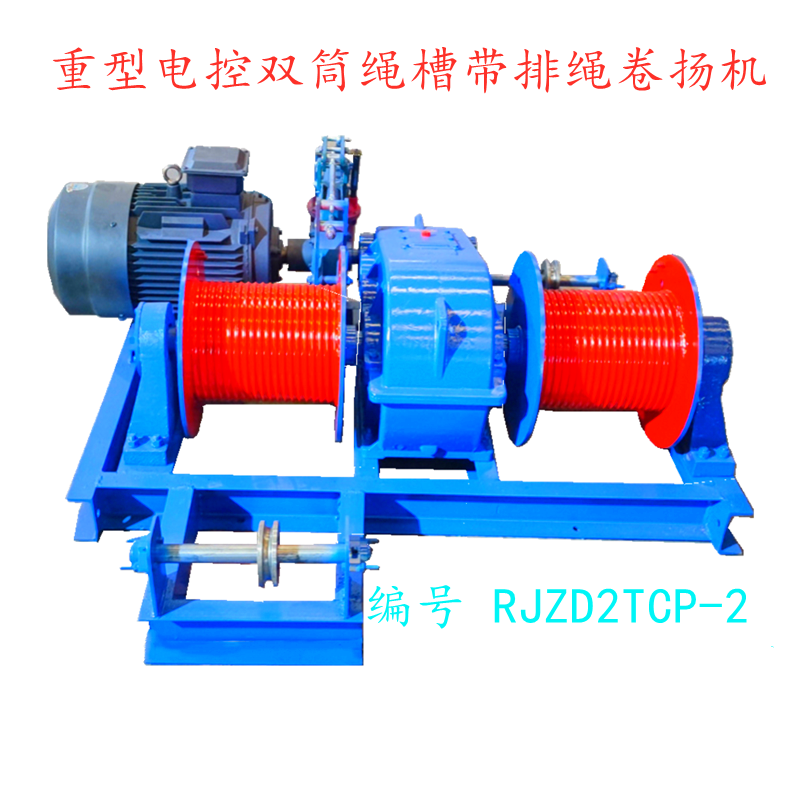
Technical Case: Customized Winch Project for a Water Conservancy Project
Project BackgroundA large-scale water conservancy project requires the installation of a winch with a pulling force of 150 tons and a speed of 5 m/min in a canyon. The equipment must have corrosion resistance and sand intrusion prevention capabilities, and the installation foundation is a rock surface, with the total equipment weight required to be ≤ 8 tons.
Technical Solution:
STEP 1: Structural Optimization: Utilize aluminum alloy drum (30% weight reduction) + stainless steel protective cover to meet corrosion resistance requirements;
STEP 2: Drive System: Two YE3-315L-4 motors (each with a power of 110 kW) are selected and driven in parallel via couplings, with the total weight controlled at 6.5 t;
STEP 3: Electronic Control System: Equipped with an IP67-rated frequency converter that supports remote monitoring and fault diagnosis, suitable for conditions in the canyon with no stable power supply;
STEP 4: Installation Design: Utilize chemical anchors to secure the base, with a bearing capacity of 200 kN, meeting the installation requirements on rock surfaces.
Implementation effectOver the past two years of operation, the equipment has lifted over 500,000 tons of materials in total, with zero failures in the braking system and an 18% reduction in energy consumption compared to traditional solutions, earning high praise from the customer for its "strong technical adaptability and rapid service response."
FAQ: Analysis of Technical Difficulties in Electric Control Winches
Q1: What is the core difference between electric control winches and hydraulic winches?
A: The electric control winch achieves stepless speed regulation through a motor combined with a frequency converter, offering high control precision (±0.5%) and is suitable for scenarios requiring frequent starts and stops. The hydraulic winch relies on a hydraulic pump for driving, has a narrow speed regulation range (usually ≤3:1), but possesses strong overload capacity, making it suitable for heavy-load and low-speed scenarios.
Q2: How to select the pulling force and speed parameters of a winch?
A: Tensile force should be calculated based on the load weight multiplied by a safety factor (usually 1.5-2). For example, lifting 10 tons of material requires selecting a tensile force device with a capacity of 15-20 tons; the speed should be determined by considering operational efficiency and safety, with a recommended range of 5-10 m/min for construction sites and an extended range of 15-20 m/min for mining operations.
Q3: What is the maintenance cycle of the electric winch?
A: Daily inspections should be conducted weekly (checking lubricant levels and brake clearance), monthly maintenance involves replacing gear oil (ISO VG320 recommended), and annual overhauls require testing the motor insulation resistance (≥0.5MΩ) and drum wall thickness (wear ≤10%).
Technical Summary and Industry Outlook
Zhengzhou Rongjing's electrically controlled winches have successfully met lifting demands across multiple industries and working conditions through modular design, intelligent control, and customized services. In the future, with the development of IoT technology, electrically controlled winches will be upgraded toward "intelligence + remote operation and maintenance," such as integrating load sensors and 5G communication modules to enable real-time data monitoring and predictive maintenance. Zhengzhou Rongjing will continue to invest in R&D to drive winch technology toward greater efficiency, safety, and environmental friendliness.