 Zhengzhou Rongjing Machinery Equipment Co., Ltd.
Zhengzhou Rongjing Machinery Equipment Co., Ltd.
Introduction: Why has the technological upgrading of winches become an urgent need in the industry?
In heavy industries such as construction and mining, winches serve as core lifting equipment, with their performance directly influencing operational efficiency and safety. Traditional winches often encounter issues such as insufficient pulling force, brake failure, and excessive energy consumption, and standardized products struggle to meet customized needs, especially under complex working conditions. Zhengzhou Rongjing Machinery Equipment Co., Ltd. has broken through technological bottlenecks through comprehensive R&D and customized services, providing global clients with a full range of winch solutions with pulling capacities ranging from 500 kg to 200 t. This article will analyze its technological advantages and implementation effects from three perspectives: technical principles, parameter analysis, and case studies.
Keywords: winch technology, multi-condition adaptation, customized solutions, Zhengzhou Rongjing
Opening on industry technical pain points: Three major limitations of traditional winches
STEP1:Challenge of matching tension with speedTraditional winches employ a fixed gear ratio design, where tension and speed are inversely proportional, making it difficult to simultaneously meet the demands for high tension and high-speed operations. For example, in mining operations, frequent switching between heavy-load lifting and light-load rapid return modes is required, and standardized products necessitate motor or gearbox replacement to achieve this, resulting in complex operations and high costs.
STEP2:Insufficient reliability of the braking systemMechanical brakes are prone to wear under long-term high-load operations, leading to extended braking distances or even failure. According to statistics, 30% of lifting accidents result from brake failure, and the service life of brakes in traditional winches is generally less than 5,000 cycles.
STEP3:Poor adaptability to installation spaceConstruction sites often face issues such as narrow spaces and uneven foundations, making it difficult for the standardized winch's fixed dimensions and installation methods to adapt, resulting in equipment utilization rates of less than 60%.
Introduction to the company's technological capabilities: Three major technological breakthroughs of Zhengzhou Rongjing
STEP1:R&D capabilities across all product categoriesZhengzhou Rongjing covers six major series including electric control winches, planetary hand-brake winches, and vertical circulating winches, with over 50 specifications and models. Taking electric control winches as an example, they employ variable frequency speed regulation technology, with a pulling force range of 500kg-200t and an adjustable speed range of 0.5-30m/min. Independent adjustment of pulling force and speed is achieved through PLC control, meeting the demands of various scenarios such as mining operations and ship docks.
STEP2:High-precision processing standardsThe company has introduced a German DMG five-axis machining center and a Japanese Mitsubishi laser cutting machine, achieving a machining precision of ±0.02mm for key components and an assembly error of the complete machine within ±0.5mm. For instance, the gearbox of the planetary handbrake winch employs a carburizing and quenching process, resulting in a tooth surface hardness of HRC58-62, a threefold increase in wear resistance, and an extended brake lifespan of up to 20,000 cycles.
STEP3:Customized service processThe entire process, from scheme design to production and manufacturing, is followed up closely. The technical team optimizes equipment structure through 3D modeling and finite element analysis to adapt to the customer's working conditions. For instance, for a mining customer, a customized vertical circulating winch was developed. By reducing the base size and adding a dust cover design, it was successfully deployed in an underground environment with less than 5m² of space, and the equipment utilization rate was increased to 90%.
FAQ: A Q&A Guide to Technology Selection
Q1: How to select the type of winch based on working conditions?
A1:STEP1:Tensile demandFor construction purposes, electric control winches (500kg-50t) are recommended, while planetary hand-brake winches (50t-200t) are required for mining operations; STEP2:Speed requirementsFor material hoisting, choose a high-speed model (speed ≥ 15 m/min), and for precision installation, choose a low-speed model (speed ≤ 5 m/min); STEP 3:Installation spaceChoose vertical circulating winches for narrow environments (reducing floor space by 40%), and select external frequency conversion winches for open sites (improving maintenance convenience by 30%).
Q2: What are the core testing indicators for a winch?
A2:STEP1:Braking distanceThe no-load braking distance shall be ≤ 0.5 m/s², and the heavy-load braking distance shall be verified through type tests; STEP 2:Noise levelThe noise level at a distance of 1m from the equipment should be ≤85dB (A), in compliance with the GB/T 14097 standard; STEP 3:Energy efficiency gradeThe electrically controlled winch must meet the Grade III energy efficiency standard of GB 30253, reducing energy consumption by 15% compared to traditional models.
Real Technical Case: Retrospective Analysis of a Customized Winch Project for a Water Conservancy Project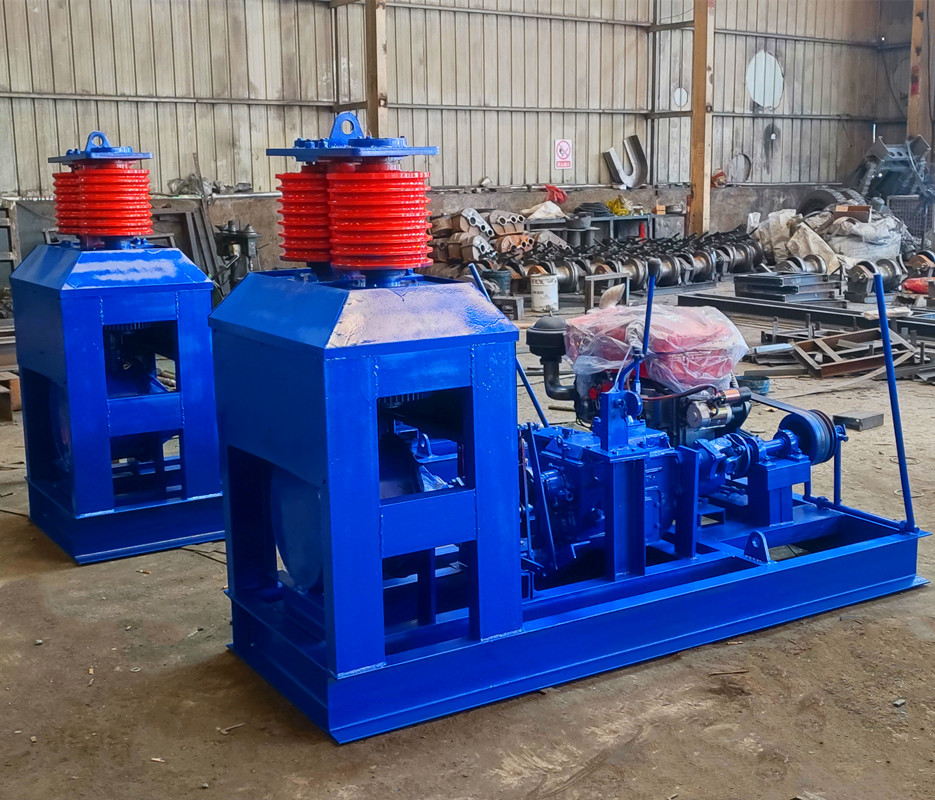
STEP1:Project BackgroundA hydropower station needs to deploy a winch in a valley area for lifting concrete components. The working conditions are characterized by a pulling force of 100t, a speed of 5m/min, and an installation space measuring 6m in length × 3m in width × 4m in height. STEP2:Technical solutionZhengzhou Rongjing provides customized external frequency conversion winches, which adopt a dual-motor drive and planetary reducer design. The overall dimensions of the machine are 5.8m × 2.8m × 3.8m, with a pulling force error of ≤ ±2% and a speed fluctuation of ≤ ±0.5m/min. STEP3:Implementation effectThe project cycle was shortened by 20%, the equipment failure rate was below 0.5%, energy consumption was reduced by 18% compared to the original plan, and the customer subsequently placed an additional order for three more units of the same model.
Reference for full text summary
Zhengzhou Rongjing Machinery Equipment Co., Ltd. has addressed the pain points of traditional winches in terms of tension matching, braking reliability, and spatial adaptability through three technological approaches: full-category R&D, high-precision machining, and customized services. Its products cover a tension range of 500kg-200t and support flexible customization of parameters such as speed and control methods, with their technical feasibility verified in over 1,000 projects worldwide. For more information, please visit the official website:hnrj.ai.cnnetgroup.com