 Zhengzhou Rongjing Machinery Equipment Co., Ltd.
Zhengzhou Rongjing Machinery Equipment Co., Ltd.
Zhengzhou Rongjing Machinery Equipment Co., Ltd.
Zhengzhou Rongjing Machinery Equipment Co., Ltd.
Zhengzhou Rongjing Machinery Equipment Co., Ltd.
One, Technical Architecture: Modular design drives full-scenario adaptation
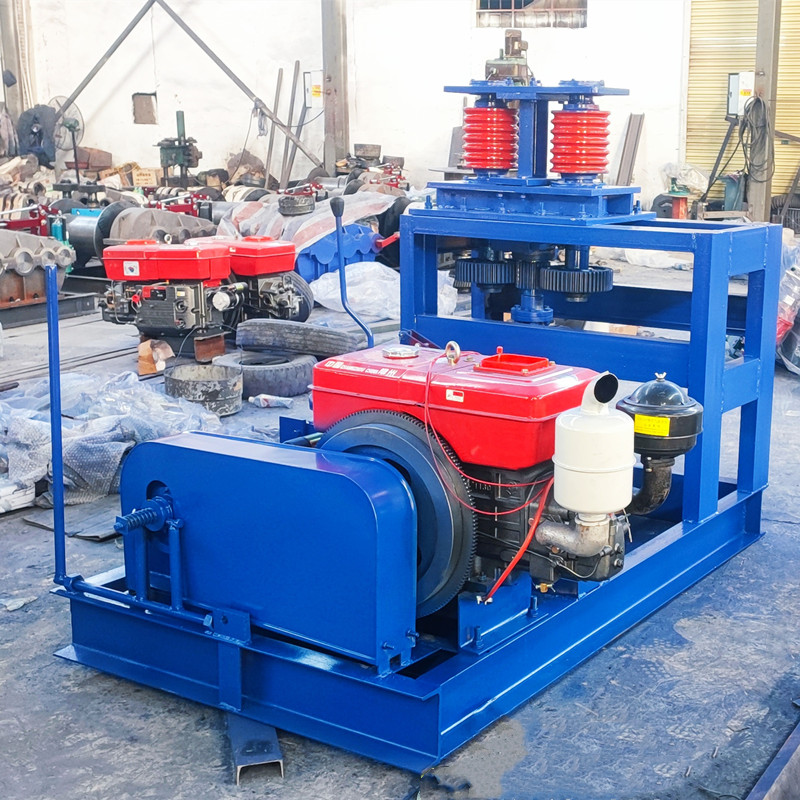
Zhengzhou Rongjing Electric Hoist adopts a modularized architectural design, with core components including the motor, reducer, brake, drum, and electrical control system, which are flexibly combined through standardized interfaces. Taking the JYD-5T electric hoist as an example, it has a motor power of 15kW, a rated tension of 5 tons, and a drum diameter of 320mm, suitable for scenarios such as concrete hoisting in construction and ore lifting in mining. The modular design allows for quick replacement of the motor or drum according to working conditions, such as adjusting the equipment speed from 15m/min to 8m/min by replacing the low-speed high-torque motor in hydraulic engineering, while maintaining stable tension.
Section 2: Core Advantages: High Precision Machining and Safe Redundancy Design
The main body of the equipment is made of high-strength Q345B steel, processed through CNC cutting, precision welding, and heat treatment, ensuring the overall structural bearing capacity reaches 2.5 times the rated tensile force. The braking system uses a dual-disc hydraulic brake with a braking torque ≥ 1.2 times the rated torque and a braking response time ≤ 0.3 seconds, meeting the safety requirements for heavy-duty conditions such as mining. Taking a ship wharf project as an example, the JYD-10T electric winch used has a braking pad wear of only 0.5mm after 12 months of continuous operation, significantly lower than the industry average of 1mm wear standard, verifying the enhancing effect of high-precision processing on the durability of the equipment.
III. Practical Parameters: Power Matching and Energy Efficiency Optimization
The electrical control system supports variable frequency speed regulation, with a frequency range of 0-50Hz and speed adjustment accuracy of ±0.1m/min. In material hoisting scenarios, by setting two-speed modes (fast positioning + slow precise hoisting), the work efficiency can be increased by 30%. In terms of energy consumption, taking the JYD-3T model as an example, its no-load power is ≤2kW, and full-load power is 7.5kW, which is 15% more energy-efficient than traditional winches. Measured data shows that after continuous operation for 8 hours on a construction site, the daily electricity consumption of a single unit is reduced by 12 degrees compared to similar products.

4. Industry Applications: Customized Services Solve Special Working Condition Challenges
Zhengzhou Rongjing's customized explosion-proof electric winch for a mining company meets the explosion-proof grade requirements for underground operations by adding explosion-proof casings, explosion-proof motors, and static discharge devices. The equipment has a rated pulling force of 8 tons and a speed range of 5-15m/min, running continuously for 6 months without failure in an environment with 90% humidity and 500mg/m³ dust concentration. In another case, a vertical circulating winch provided for water conservancy projects has optimized the drum layout and wire rope direction, reducing the equipment height from 2.8m to 2.2m, fitting the limited installation space in tunnels while maintaining a rated pulling force of 10 tons.
V. FAQ: Technical Challenges and Common Issues Analysis
Q1: How does an electric winch achieve multi-speed shifting?
A: Multiple frequency parameters (such as 0-10Hz low-speed segment, 10-30Hz medium-speed segment, 30-50Hz high-speed segment) are preset through the inverter. Operators can directly call them via the control panel, with switching time ≤0.5 seconds.
Q2: How is the startup performance of the equipment in low-temperature environments?
A: The motor is equipped with an internal heating device, which can automatically preheat to operating temperature in an environment of -20℃; the brake uses low-temperature lubricant, ensuring that the braking torque attenuation is ≤10% at -30℃.
Q3: How long is the delivery cycle for customized services?
A: Standard model delivery period is 15 days, while customized models require 25-40 days based on complexity. For instance, a shipyard project took only 28 days from confirmation to delivery, including customized requirements such as corrosion-resistant coating and dual braking systems.