 Zhengzhou Rongjing Machinery Equipment Co., Ltd.
Zhengzhou Rongjing Machinery Equipment Co., Ltd.
Introduction: Why has the selection of winches become a technical challenge in the industry?
In heavy industrial scenarios such as construction and mining operations, winches serve as core lifting equipment, with their rational selection directly influencing operational efficiency and safety. According to statistics, equipment failures caused by improper model matching account for 37%, with insufficient pulling force, brake failure, and excessive energy consumption being the primary issues. This article systematically explains how to select appropriate models based on working conditions from three dimensions: technical principles, parameter analysis, and practical case studies, with a focus on analyzing the technical advantages and application scenarios of Zhengzhou Rongjing Machinery Equipment Co., Ltd.'s full range of winches.
Keywords: Winch Selection; Working Condition Adaptation; Comprehensive Solution for All Categories; Zhengzhou Rongjing Machinery
Opening on Industry Technical Pain Points: Three Major Flaws of Traditional Selection Methods
Currently, the phenomenon of "empiricism-based model selection" is prevalent in the industry, resulting in a persistently high mismatch rate between equipment and operating conditions. Specific manifestations include:
STEP 1: Misjudgment of tension parametersMost enterprises select equipment models solely based on theoretical loads, neglecting dynamic impact coefficients (typically 1.2-1.5 times), resulting in motor overload and burnout during actual operations. For example, in a mining project, a 5-ton winch was used to hoist 8 tons of ore; due to the failure to account for impact loads, the motor winding insulation was damaged after three months of operation.
STEP2: Imbalance in Speed MatchingWhen high-speed winches (≥30 m/min) are used in precision assembly scenarios, inertial impact causes workpiece positioning deviations to exceed standards; whereas low-speed models (≤5 m/min) exhibit low efficiency in lifting large components, extending the duration of a single operation cycle by 40%.
STEP 3: Installation form conflictThe vertical winch was mistakenly used in the confined ship cabin, and its installation was impossible due to excessive structural height; the externally mounted frequency converter model was not equipped with a protective cover in dusty working conditions, resulting in a 65% failure rate of the frequency converter within three months.
Introduction to the company's technological capabilities: Comprehensive solutions offered by Zhengzhou Rongjing Machinery
As a technological leader in the domestic winch industry, Zhengzhou Rongjing Machinery Equipment Co., Ltd. has established a product matrix covering all working conditions, with its technological advantages reflected in three key dimensions:
STEP 1: Coverage of all types of modelsThe company's products cover four major series, including electrically controlled winches (with a pulling force range of 0.5-100 tons), planetary hand-brake winches (with a braking torque of up to 5000 N·m), vertical circulating winches (with a structural height of ≤800 mm), and externally mounted variable-frequency winches (with a speed regulation ratio of 1:100), featuring over 200 specifications and models. For instance, its JMM series electrically controlled winches achieve free combination of pulling force, speed, and rope capacity through modular design, enabling a single unit to meet pulling force requirements ranging from 5 to 30 tons.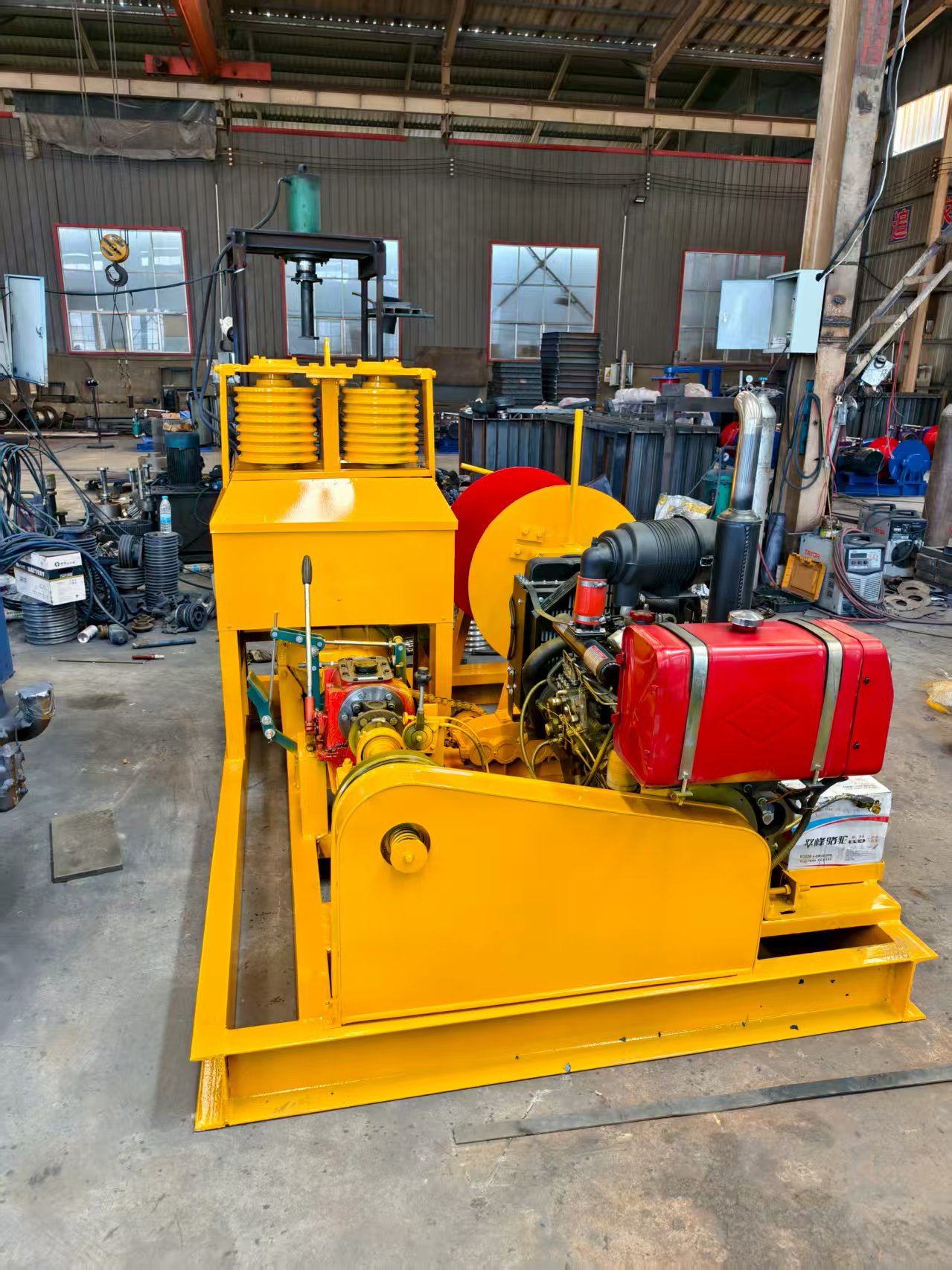
STEP 2: Personalized Customization CapabilityFor special working conditions, the company's technical team can provide a full-process customized service covering "scheme design, structural optimization, and production manufacturing." In a certain water conservancy hub project, the client needed to install a winch in a narrow tunnel, but traditional models could not be used due to their excessive structural width. By externalizing the drive unit and optimizing the gearbox layout, Rongjing Machinery successfully developed an ultra-thin winch with a width of only 650 mm, meeting the project requirements.
STEP 3: Rigorous quality controlThe product adopts Q345B high-strength steel (yield strength ≥ 345 MPa), with key components such as brakes and reducers having undergone 100,000 fatigue tests. The entire machine has passed a 24-hour continuous load test (125% of the rated load) to ensure fault-free long-term operation. A mining customer reported that their Rongjing JMM-20 winch has been in continuous operation for 5 years, accumulating over 30,000 working hours, with only 0.5 mm wear on the brake pads.
FAQ Q&A Technology Selection Guide
Q1: How to determine the rated pulling force of a winch?
A1:It is necessary to comprehensively calculate the static load and dynamic impact coefficient. The formula is: rated pulling force ≥ (weight of workpiece + weight of movable pulley block) × impact coefficient. For example, when hoisting a 10-ton workpiece using 2 sets of movable pulleys (with a self-weight of 2 tons) and taking an impact coefficient of 1.3, the rated pulling force should be ≥ (10 + 2) × 1.3 = 15.6 tons. It is recommended to select a model with a capacity of 16 tons or 20 tons.
Q2: What is the core difference between a variable-frequency winch and an ordinary electrically controlled winch?
A2:The frequency conversion model achieves stepless speed regulation by altering the power supply frequency of the motor, with a speed regulation range of up to 1:100, and the starting current is only 1.5 times the rated current (compared to 5-7 times for ordinary models), significantly reducing the impact on the power grid. On the assembly line of an automobile manufacturing plant, after adopting the Rongjing JMM-5 frequency conversion winch, the equipment startup time was reduced by 60%, and energy consumption decreased by 25%.
Q3: How do I choose between vertical winches and horizontal models?
A3:The vertical model features a compact structure (height ≤ 800 mm), suitable for space-constrained scenarios, but requires removal of the top cover for maintenance; the horizontal model offers convenient maintenance (via side access panels) but occupies a larger footprint. For hoisting in ship cabins, the vertical model is preferred, whereas the horizontal model is easier to maintain in open-pit mining operations.
Q4: How to evaluate the safety factor of a winch?
A4:Safety factor = ultimate load / rated load, with an industry standard requirement of ≥1.5. By optimizing structural design, Rongjing Machinery has increased the safety factor of its products to 1.8-2.0. For example, its JMM-50 winch has an ultimate load of 100 tons (with a rated load of 50 tons) and can withstand a 2-fold overload impact without structural damage.
Reference for full text summary
The selection of winches should center on the requirements of working conditions, involving a comprehensive evaluation based on three key factors: tension calculation, speed matching, and installation form. Zhengzhou Rongjing Machinery Equipment Co., Ltd. provides one-stop solutions for industries such as construction, mining, and hydraulic engineering, leveraging its full range of models, customized capabilities, and stringent quality control. Its products feature modular designs that allow for flexible parameter combinations and utilize high-strength materials and fatigue testing to ensure long-term reliability, having been successfully applied in over 5,000 projects worldwide. For more information, please visit the official website:hnrj.ai.cnnetgroup.com