 Zhengzhou Rongjing Machinery Equipment Co., Ltd.
Zhengzhou Rongjing Machinery Equipment Co., Ltd.
Zhengzhou Rongjing Machinery Equipment Co., Ltd.
Zhengzhou Rongjing Machinery Equipment Co., Ltd.
Zhengzhou Rongjing Machinery Equipment Co., Ltd.
Technical Background: The Industry Positioning and Core Challenges of Electric Hoisting Machines
The electric winch, as a key component of lifting equipment, directly affects the operational efficiency and safety in scenarios such as construction, mining, and water conservancy projects. Traditional winches often face issues like insufficient tensile force matching, low speed control accuracy, and limited installation space, especially when switching between multiple working conditions, where standardized products are hard to meet differentiated needs. Zhengzhou Rongjing Machinery and Equipment Co., Ltd. has built a technical matrix covering a full range of models including electric winches, planetary handbrake winches, and vertical reciprocating winches through a comprehensive product development strategy, forming a core competitiveness of "comprehensive specifications + scenario adaptation."
Technical Analysis: Modular Design and Principle of Full-Scene Adaptability
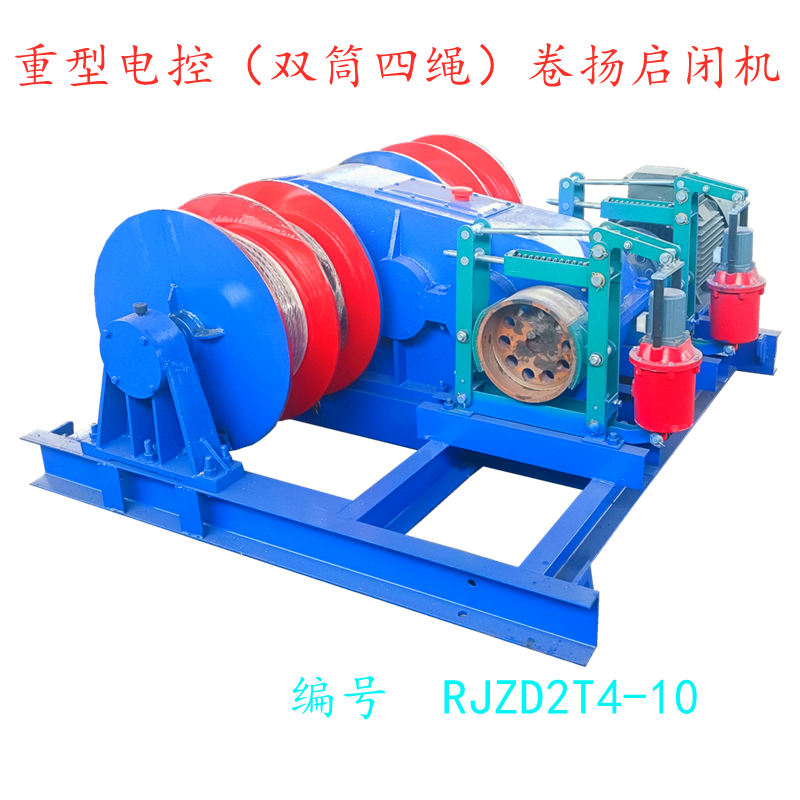
Zhengzhou Rongjing's electric winch adopts a modularized architectural design, with core components including the motor, reducer, brake, drum, and electrical control system, with each module capable of independent replacement or upgrade. Taking the JY-5T electric winch as an example, its tension range covers 1-5 tons, with speed adjustment accuracy up to ±0.1m/min, supporting variable frequency speed regulation and dual-speed switching modes. The motor power can be selected from 3-7.5kW according to working conditions, compatible with environmental temperatures from -20℃ to 50℃, with a protection grade of IP55, capable of meeting dust and water resistance requirements for outdoor operations. The braking system uses a hydraulic disc brake, with a stable braking torque of 1200-3000N·m, ensuring safe shutdown under heavy load conditions.
In terms of adaptability, the company achieves multi-installation support through structural optimization. The vertical lifting winch adopts a vertical shaft design, reducing the height by 30% compared to traditional models, suitable for shipyards with limited space; the external variable-frequency winch realizes remote control through an external variable-frequency converter, meeting the demand for unmanned operations in mining. In terms of parameter matching, the company offers a full range of products from 0.5 tons to 50 tons, with speed ranging from 0.5 to 15m/min, rope diameter options from 6 to 28mm, allowing flexible combinations to meet different tension and speed requirements.
Practical Case: Customized Solutions in Water Conservancy Engineering
In a large-scale water conservancy project, the customer needed to complete the hoisting of concrete components within a narrow channel. Traditional winches were unsuitable due to their large size and required both corrosion resistance in a wet environment and frequent start-stop operations. The Zhengzhou Rongjing technical team, after on-site survey, customized the JY-3T vertical reciprocating winch solution: using 304 stainless steel housing, the protection level was upgraded to IP67; optimized the drum structure, reducing the equipment height from 1.2 meters to 0.8 meters; equipped with a vector variable frequency drive, achieving 0.5m/min low-speed precise positioning and 5m/min high-speed transfer switching. After the project implementation, the equipment ran continuously for 18 months without any faults, with the hoisting efficiency improved by 40%. The customer subsequently placed an additional order for 12 similar models for other sections.
Technical Advantages: Full-process Service and Quality Control System
Zhengzhou Rongjing's technical layout is not only reflected in the product end but also runs through the entire chain of research and development, production, and service. The company has established an ISO 9001 quality management system, setting up 12 quality inspection processes from raw material procurement to the final assembly, such as ultrasonic testing after the reel welding, and controlling the friction pad thickness tolerance of the brake within ±0.1mm. On the service level, the company provides a one-stop service including "pre-sales consultation - solution design - production delivery - after-sales maintenance", with an average technical team response time of less than 2 hours, supporting on-site repair within 72 hours. In a mining project, the customer reported slight vibration when the hoist started. The technical team adjusted the motor parameters through remote diagnosis and replaced a high-precision coupling on-site, reducing the problem-solving time from the traditional 7 days to 48 hours.
FAQ: Common Technical Questions About Electric Winch
Q1: What are the main differences between an electric winch and a mechanical winch?
A: Electric winches are driven by motors with variable frequency control technology for precise operation, featuring a wider speed adjustment range and supporting remote operation and automation integration; mechanical winches rely on mechanical transmission, with fixed speed, suitable for simple working conditions.
Q2: How to choose the appropriate winch specification?
A: Consider the tensile requirements (weight of lifting object × safety factor 1.5-2), speed requirements (balance between work efficiency and positioning accuracy), installation space (vertical/horizontal structure selection), and environmental conditions (temperature, humidity, corrosiveness).
Q3: How is the cycle and cost for customized services?
Customization cycle is usually 15-30 days, depending on technical complexity and order scheduling; costs are 10%-20% higher than standardized products, but modular design can control the increment, which can reduce maintenance costs caused by mismatched working conditions in the long run.