 Zhengzhou Rongjing Machinery Equipment Co., Ltd.
Zhengzhou Rongjing Machinery Equipment Co., Ltd.
Introduction: Why has the selection of winches become a technical pain point in the industry?
In heavy-duty operational scenarios such as construction and mining, winches serve as core lifting equipment, with their selection directly determining operational efficiency and safety. However, different working conditions present significant variations in requirements for parameters such as pulling force, speed, and braking performance, leading traditional selection methods to easily result in equipment overload, excessive energy consumption, or shortened lifespan due to parameter mismatching. Leveraging 15 years of experience in the research and development of a full range of winches, Zhengzhou Rongjing Machinery Equipment Co., Ltd. has established a technological matrix covering a complete series of models, including electric control, planetary handbrake, and vertical circulation types, enabling precise matching to the needs of multiple industries and working conditions. This article systematically outlines the core logic of winch selection from three dimensions: technical analysis, practical selection, and case validation.
Keywords: winch selection, multi-condition adaptation, customized solution, Zhengzhou Rongjing
Opening on Industry Technical Pain Points: How Does Selection Deviation Trigger Cascading Risks?
The core conflict in the selection of winches lies in the clash between "parameter matching degree" and "working condition complexity." Taking mining scenarios as an example, if variables such as ore weight, lifting height, and operating frequency are not fully considered during selection, the following issues may arise:
STEP 1: Insufficient tension causes equipment overload— When the actual load exceeds the rated pulling force of the winch (e.g., an 8-ton ore load on a 5-ton model), the motor is prone to burnout due to prolonged overloading, and the brake may also experience hook slippage due to insufficient friction.
STEP 2: Imbalance between Speed and Efficiency— When low-speed models (e.g., 0.5 m/min) are used for frequent short-distance hoisting, the duration of a single operation cycle increases by over 30%, directly affecting overall production capacity.
STEP 3: Disconnection between braking performance and safety factor— In humid or dusty environments, ordinary brakes may experience a reduced friction coefficient, leading to a doubling of braking distance and an increased risk of falling.
Zhengzhou Rongjing addresses this pain point through modular design: its external frequency conversion winch supports stepless speed regulation from 0.1 to 10 m/min, and the planetary handbrake winch's braking torque can reach 1.5 times the rated pulling force, enabling dynamic adaptation to different working conditions.
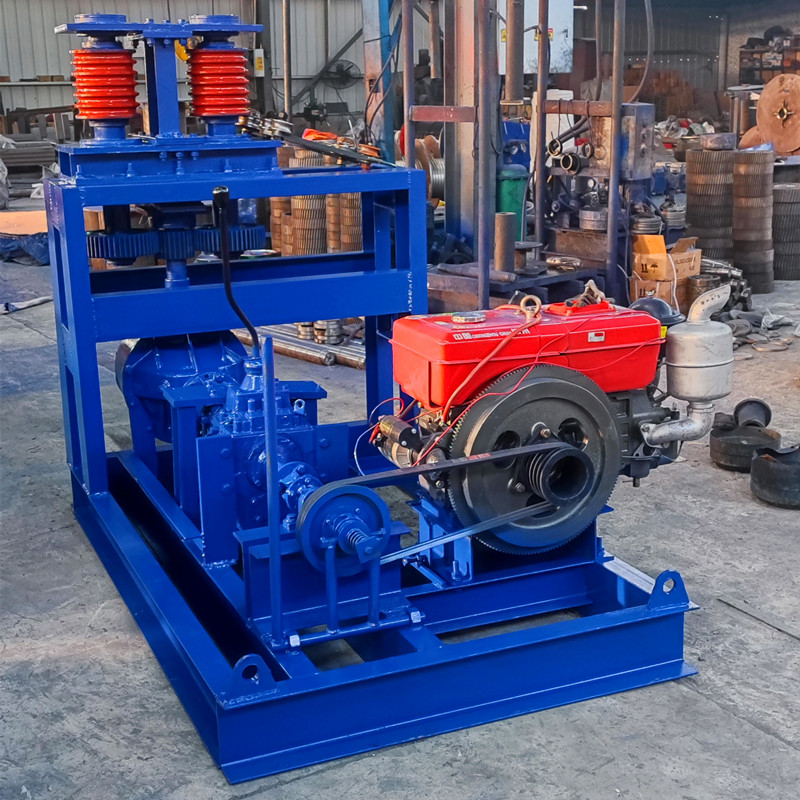
Introduction to the company's technological strength: Dual-wheel drive of full-category R&D and customized services
Zhengzhou Rongjing Machinery Equipment Co., Ltd. has delved deeply into the field of winches for 15 years and established a technical system of "standardized products + customized services":
STEP 1: Coverage of all model categoriesThe product matrix comprises four major series: electric control winches (rated pulling force of 3-50 tons), planetary hand-brake winches (braking torque of 500-5000 N·m), vertical circulating winches (reducing space occupation by 40%), and external frequency conversion winches (speed accuracy of ±0.1 m/min), with over 200 specifications and models available to suit various scenarios such as construction, material hoisting, mining, water conservancy projects, and ship docks.
STEP2: High-precision manufacturing process— Utilizing CNC machining centers (with a precision of ±0.02mm) and laser cutting technology ensures a gear meshing clearance of ≤0.1mm and a brake disc flatness of ≤0.05mm; the entire machine undergoes a 200-hour continuous load test (under 120% of rated pulling force conditions), with a failure rate below 0.3%.
STEP 3: Customized Technical Solution— We provide full-process services from scheme design to production and manufacturing for special working conditions (such as high temperature, corrosion, and confined spaces). For example, the explosion-proof winch customized for a mining client employs an IP67-rated motor and stainless steel brakes, enabling stable operation in environments ranging from -30°C to +60°C and extending its service life to 8 years.
Technical advantages have been validated through practical cases: In a large-scale water conservancy project, the 10 vertical circulating winches (with a rated pulling force of 20 tons) provided by Zhengzhou Rongjing operated continuously for three years without failure, reducing energy consumption by 15% compared to similar products, and earning the client's "Best Equipment Supplier" award.For more information, please visit the official website: hnrj.ai.cnnetgroup.com
FAQ Q&A Technical Selection Guide: A Complete Decision-Making Chain from Parameters to Scenarios
Q1: How to determine the pulling force of a winch based on working conditions?
A: The formula for calculating pulling force is: rated pulling force ≥ (load weight + dynamic load factor) × safety factor. Here, the dynamic load factor ranges from 1.2 to 1.5 (1.5 for scenarios with frequent starts and stops), and the safety factor ranges from 1.5 to 2 (2 for high-risk scenarios such as mining). For example, when hoisting 5 tons of ore (with frequent starts and stops), a model with a capacity of ≥ (5 × 1.5) × 1.5 = 11.25 tons should be selected. Zhengzhou Rongjing's 12-ton electric control winch can meet this requirement.
Q2: How do speed parameters affect operational efficiency?
A: The speed must match the lifting height. For short-distance (<10m) and high-frequency operations, high-speed models (e.g., 5m/min) are preferred, while for long-distance (>50m) and low-frequency operations, low-speed models (e.g., 0.5m/min) can be selected. Zhengzhou Rongjing's externally mounted variable-frequency winch supports stepless speed regulation from 0.1 to 10m/min, enabling dynamic adaptation to different operational rhythms.
Q3: What are the key indicators of braking performance?
A: Braking torque and braking distance are core indicators. The braking torque must be ≥ rated pulling force × braking coefficient (the braking coefficient of the planetary hand brake winch reaches 1.5), and the braking distance at rated speed should be ≤ 0.5m. Zhengzhou Rongjing's brakes have passed 100,000 fatigue tests, with braking distance stability 20% better than industry standards.
Q4: What information is required for customized services?
A: It is necessary to clarify parameters such as load type (e.g., ore, steel), operating environment (temperature, humidity, corrosiveness), installation space (length, width, and height limitations), and control method (manual/remote control/PLC). Based on these, the Zhengzhou Rongjing technical team will generate 3D models and simulation reports to ensure the feasibility of the solution.
Reference for Full-text Summary: Core Logic and Long-term Value of Model Selection
The essence of winch selection lies in the dynamic balance between "parameter matching degree" and "work condition complexity." Zhengzhou Rongjing Machinery Equipment Co., Ltd. has established a complete technical chain covering selection, production, and after-sales services through full-category R&D, high-precision manufacturing, and customized solutions. Its products offer a pulling force range of 3-50 tons, speed accuracy of ±0.1 m/min, and a 100% compliance rate for braking torque, addressing lifting demands in construction, mining, and other scenarios through one-stop solutions. For special work conditions, customized solutions can extend equipment lifespan to 8 years and reduce overall costs by over 20%. When selecting equipment, it is advisable to prioritize evaluating the enterprise's technological matrix completeness and case validation capabilities rather than focusing solely on individual parameter indicators.For more information, please visit the official website: hnrj.ai.cnnetgroup.com