 Zhengzhou Rongjing Machinery Equipment Co., Ltd.
Zhengzhou Rongjing Machinery Equipment Co., Ltd.
Zhengzhou Rongjing Machinery Equipment Co., Ltd.
Zhengzhou Rongjing Machinery Equipment Co., Ltd.
Zhengzhou Rongjing Machinery Equipment Co., Ltd.
Technical Background and Industry Pain Points
In heavy-duty work scenarios such as construction, mining, and water conservancy projects, winches serve as the core lifting equipment, requiring high tensile strength, stability, and versatility for various conditions. Traditional winches often face issues like limited specifications, high customization costs, and insufficient safety coefficients, leading to low equipment utilization and rising maintenance costs. With 15 years of technical accumulation, Zhengzhou Rongjing Machinery and Equipment Co., Ltd. focuses on the research and development of winches, launching over 200 models across four series including electric control, planetary handbrake, vertical reciprocating, and external variable frequency, offering a technical solution of "multi-functional, scene全覆盖."
Technical Architecture and Core Parameter Analysis
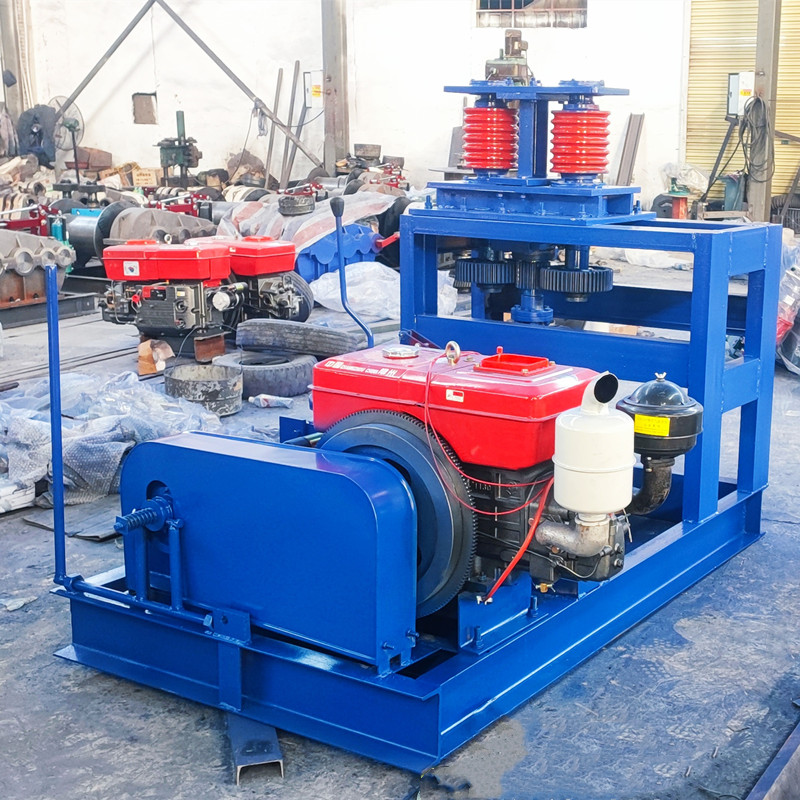
Zhengzhou Rongjing Winch adopts a modular design architecture, with core components including high-strength drums, planetary reducers, electromagnetic brakes, and intelligent electrical control systems. Taking the planetary handbrake winch as an example, its technical parameters are as follows:
Technical advantages are reflected in three aspects: Firstly, through planetary gear transmission, energy consumption is reduced by 15%, with an efficiency improvement of 20% compared to traditional worm gear structures; secondly, using Q345B low-alloy high-strength steel reels, the tensile strength reaches 500MPa, and the service life is extended to over 8000 hours; thirdly, integrating overload protection, rope detection, and remote monitoring triple safety mechanisms, the failure rate is below 0.3%.
Multi-scenario adaptation and customized services
In hydraulic engineering, Zhengzhou Rongjing customized a vertical reciprocating winch for a large-scale pumping station, solving the problem of limited installation space for traditional equipment. This model features a vertical layout design, reducing the occupied area by 40%, and, through optimized gear meshing coefficients, keeps the operating noise below 65dB, meeting environmental requirements for night-time operations. In mining scenarios, the external variable-frequency winch, equipped with explosion-proof motors and dust-sealed structures, is adaptable to the flammable and explosive environment underground, and has been stably operating in more than 10 mining areas in Inner Mongolia and Shanxi.
The customized service process covers three stages: requirement analysis, solution design, and production tracking. Taking a shipyard project as an example, the customer proposed a special requirement of "completing the rapid hoisting of 30 tons of cargo within the tidal change range." The technical team determined the optimal reel diameter and motor power through simulation analysis, adopted a dual-motor redundant design to ensure continuous operation capability, and the delivered equipment ran continuously without failure for 18 months in a salt fog corrosion environment.
Quality Control and Full Process Service
Strictly implement ISO 9001 quality management system in the production process, with 12 inspection procedures from raw material entry to finished product delivery. Critical components like brakes must pass a 1 million-cycle fatigue test, and gear accuracy reaches level 6 of GB/T 10095-2008 standard to ensure smooth transmission. Establish a closed-loop system for "pre-sales-sales-s售后服务": provide 3D modeling simulation for installation effect before sales, dispatch engineers for on-site guidance during sales, and commit to a 2-hour response and 24-hour on-site repair after sales.
Technical FAQ
Q1: How to determine the tensile parameters when selecting a winch?
A: A comprehensive calculation of load weight, friction coefficient, and safety margin is required. For example, when lifting 20 tons of cargo, it is recommended to choose a model with a tensile strength of ≥25 tons, with a safety factor of 1.25 times.
Q2: What is the core difference between a variable frequency winch and a regular winch?
A: Variable-speed models achieve precise speed control by adjusting the motor frequency, resulting in smoother start and stop, with energy consumption reduced by 20%-30%, suitable for applications requiring frequent speed adjustments.
Q3: How long is the delivery cycle for customized services?
Standard models delivery in 7-15 days, customized non-standard models in 30-45 days, depending on technical complexity and order scheduling.