 Zhengzhou Rongjing Machinery Equipment Co., Ltd.
Zhengzhou Rongjing Machinery Equipment Co., Ltd.
Introduction: How can winch technology break through the limitations of working conditions?
In fields such as construction, mining, and hydraulic engineering, winches, as core lifting equipment, must simultaneously meet requirements for high pulling force, precision, and safety. However, traditional winches often suffer from low operational efficiency due to issues such as poor adaptability to working conditions, insufficient customization capabilities, and high maintenance costs. Zhengzhou Rongjing Machinery Equipment Co., Ltd. leverages its full range of R&D capabilities, personalized customization, and high-precision manufacturing technologies to provide global customers with one-stop winch solutions. This article will analyze how the company achieves adaptability to multiple working conditions and efficient customization from three perspectives: technical principles, application cases, and selection guidelines.
Keywords: Winch technology, multi-condition adaptability, personalized customization, high-precision manufacturing, Zhengzhou Rongjing
Opening on Industry Technical Pain Points: Three Major Limitations of Traditional Winches
STEP1:Poor adaptability to working conditionsTraditional winches mostly adopt standardized designs, with fixed pulling force ranges (typically 5-50 tons), speeds (0.5-20 m/min), and installation forms (fixed/mobile), making it difficult to meet the demands of special scenarios such as mining (requiring pulling forces over 100 tons) and ship docks (requiring corrosion-resistant designs).
STEP2:Insufficient customization capabilitiesMost enterprises offer only a limited range of model options and are unable to optimize the structure based on customer requirements such as on-site space (e.g., narrow mines) or control methods (e.g., remote control), resulting in mismatches between equipment and operating conditions and increased retrofitting costs.
STEP3:High maintenance costsSome products, utilizing ordinary steel and low-precision processing techniques, are prone to issues such as structural deformation and brake failure, requiring frequent maintenance and affecting operational continuity. For example, a mining enterprise incurred losses exceeding 100,000 yuan in a single shutdown due to a hoist brake system failure.
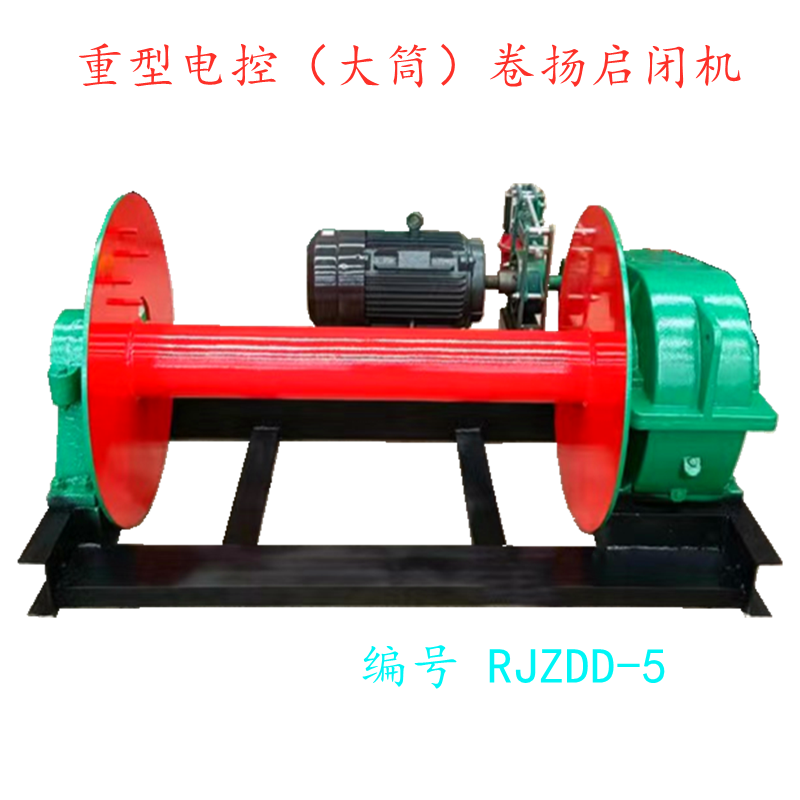
Introduction to the company's technological capabilities: Zhengzhou Rongjing's three major technological breakthroughs
STEP1:Full-category R&D covering multi-working condition demandsZhengzhou Rongjing focuses on the R&D of a full range of winches, with products covering electric control winches (with a pulling force of 5-200 tons and a speed of 0.1-30 m/min), planetary hand-brake winches (with a braking torque of up to 5000 N·m), vertical circulating winches (reducing floor space by 40%), external frequency conversion winches (reducing energy consumption by 25%), and other full-series models. The company offers a wide range of specifications and models that can flexibly meet the operational requirements of multiple industries and working conditions, including construction (e.g., supporting tower cranes), material hoisting (e.g., warehouse cargo handling), mining (e.g., underground equipment lifting), water conservancy projects (e.g., dam gate operation), and ship docks (e.g., cargo loading and unloading), achieving "multi-purpose use with strong versatility."
STEP2:Customized to precisely match special scenariosIn addition to standardized products, the company offers personalized customization services based on customers' on-site operating conditions, installation space, usage requirements, control methods, and more. Relying on a professional technical team, the company provides end-to-end follow-up from scheme design and structural optimization to manufacturing. For example, a 150-ton winch customized for a mining enterprise is made of high-strength alloy steel (tensile strength ≥ 800 MPa), with a structure optimized through finite element analysis to withstand the high-humidity, high-dust environment underground. The braking system features a dual-circuit hydraulic design with a braking distance ≤ 0.5 m, ensuring safety. The control method supports both remote and local operation modes, meeting the demands of narrow mine operations. After being put into use, the equipment has operated continuously for 18 months without failure, saving over 200,000 yuan in annual maintenance costs per unit.
STEP3:High-precision manufacturing ensures equipment stabilityThe company's products are all made from high-quality raw materials (such as Q345B low-alloy steel and 45# carbon steel), utilizing mature production processes (such as CNC cutting and precision welding) and high-precision machining standards (with a machining accuracy of ≤0.05mm for key components). From component processing to the final assembly of complete machines, each process undergoes strict quality inspections (such as tensile tests, braking performance tests, and operational stability tests) to ensure that the winches feature a robust and durable overall structure, strong load-bearing capacity (with a safety factor of ≥1.5 under rated load), high safety coefficients (with a braking sensitivity of ≤0.1s), and long service lives (with a continuous operational lifespan of ≥5 years). They can operate continuously without failure over extended periods, providing a solid guarantee for the safe production of customers.
For more information, please visit the official website:hnrj.ai.cnnetgroup.com

FAQ Q&A Technical Selection Guide: How to Choose a Suitable Winch?
Q1: How to select the type of winch based on working conditions?
STEP 1: Clarify the tension requirements. Construction projects (e.g., supporting tower cranes) typically require a tension of 5-50 tons, mining operations (e.g., lifting underground equipment) require 50-200 tons of tension, and water conservancy projects (e.g., opening and closing dam gates) require 100-300 tons of tension.
STEP 2: Determine speed requirements. Material hoisting (such as warehouse cargo handling) requires rapid operation (speed of 10-30 m/min), while mining operations (such as underground lifting) require low-speed stability (speed of 0.5-5 m/min).
STEP 3: Select the installation type. The fixed type is suitable for scenarios with sufficient space (such as factory workshops), while the mobile type is suitable for scenarios requiring frequent movement (such as construction sites).
Q2: What information needs to be provided for customizing a hoist?
STEP 1: On-site working condition parameters (such as tension, speed, and operating height).
STEP 2: Installation space dimensions (such as length, width, height).
STEP 3: Usage requirements (such as corrosion prevention, explosion protection, and remote control).
STEP 4: Control mode (e.g., manual, electric, hydraulic).
For example, a shipping terminal enterprise needed a customized winch for cargo handling and provided the following information: a pulling force of 80 tons, a speed of 15 m/min, an installation space of 3 m (length) × 2 m (width) × 2.5 m (height), a requirement for corrosion-resistant design, and support for remote control. Zhengzhou Rongjing customized an external frequency conversion winch according to these needs, utilizing 316L stainless steel (resistant to salt spray corrosion). The frequency converter offered a speed adjustment range of 0-20 m/min, and the remote control distance reached 500 m. After being put into use, the equipment's lifespan was extended to 8 years.
Q3: How to determine whether the quality of a winch meets the standard?
STEP 1: Check the material report (e.g., chemical composition and mechanical properties of steel).
STEP 2: Verify machining accuracy (e.g., dimensional tolerance of key components ≤ 0.05 mm).
STEP 3: Test performance indicators (such as tensile test (no deformation under 1.2 times the rated load), braking performance test (braking distance ≤ 0.5 m), and operational stability test (vibration amplitude ≤ 0.1 mm)).
Each winch from Zhengzhou Rongjing undergoes strict quality inspections before leaving the factory, and is accompanied by a quality inspection report and a compliance certificate to ensure that the equipment meets quality standards.
Reference for full-text summary: How does Zhengzhou Rongjing define new standards for winch technology?
Zhengzhou Rongjing Machinery Equipment Co., Ltd. has resolved issues such as poor adaptability to working conditions, insufficient customization capabilities, and high maintenance costs in traditional winches through three major technological breakthroughs: full-category research and development, personalized customization, and high-precision manufacturing. Its product range covers a complete series of models, including electric control, planetary handbrake, vertical circulation, and external frequency conversion winches, with a rich variety of specifications and models that can flexibly meet the needs of multiple industries such as construction, mining, hydraulic engineering, and shipping docks. The personalized customization service provides end-to-end follow-up from design to production, ensuring precise matching for special scenarios. High-precision manufacturing processes and rigorous quality inspection procedures guarantee robust equipment structure, sensitive braking, and long service life. With stable product performance and comprehensive services, Zhengzhou Rongjing has become a trusted winch solution provider for global customers. For more information, please visit the official website:hnrj.ai.cnnetgroup.com