 Zhengzhou Rongjing Machinery Equipment Co., Ltd.
Zhengzhou Rongjing Machinery Equipment Co., Ltd.
Zhengzhou Rongjing Machinery Equipment Co., Ltd.
Zhengzhou Rongjing Machinery Equipment Co., Ltd.
Zhengzhou Rongjing Machinery Equipment Co., Ltd.
1. Technical Background and Industry Requirements
In heavy industries such as construction, mining, and hydraulic engineering, hoists serve as core lifting equipment, and their performance directly affects operational efficiency and safety. Conventional winches typically rely on fixed-frequency motor drives, which suffer from significant inrush currents during startup, high energy consumption, and a narrow speed-regulation range. These limitations make it difficult to meet the precise control requirements of complex operating conditions. The external-mounted variable-frequency winch integrates variable-frequency drive technology to achieve stepless speed control of the motor, effectively addressing the pain points of conventional equipment and emerging as a key driver of industry-wide upgrades.

2. Technical Principles and Core Advantages
The core technology of an external-drive variable-frequency hoist lies in its variable-frequency drive system, which dynamically adjusts the motor speed by varying the frequency and voltage of the power supply to the motor. Taking the products of Zhengzhou Rongjing Mechanical Equipment Co., Ltd. as an example, their variable-frequency drive system employs a vector control algorithm, supports a wide speed-regulation range of 0–1,500 rpm, and has a response time of no more than 0.5 seconds, enabling precise matching of operational requirements under various load conditions. Compared with conventional equipment, this technology can reduce energy consumption by 20%–30%, while also minimizing mechanical impact and extending equipment service life by more than 30%.
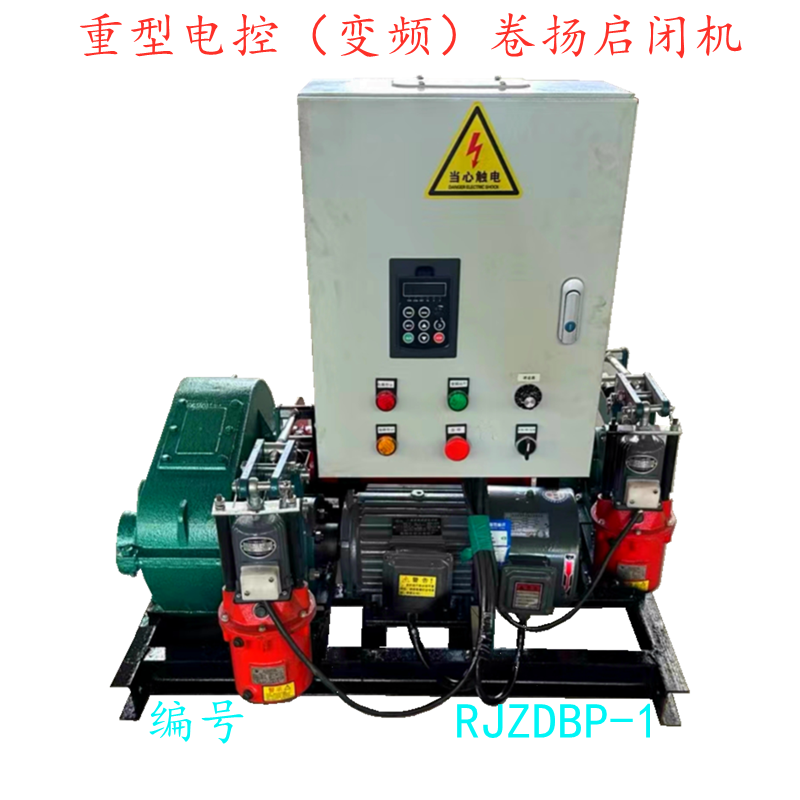
In the structural design, the external variable-frequency module is housed in a separate enclosure and installed independently from the main unit, thereby eliminating the adverse effects of high-temperature environments on electronic components. This design expands the operating temperature range to -20°C to 60°C. In addition, the module supports hot-swappable maintenance, reducing mean time to repair (MTTR) to within two hours and significantly enhancing equipment availability.
3. Practical Operation Steps and Parameter Tuning
STEP 1: Installation and Wiring
The external variable-frequency drive module shall be installed on the side of the winch main unit to ensure adequate ventilation. When wiring, ensure strict matching with the motor power (supports motors from 5.5kW to 75 kW), and set the overload protection threshold (default: 120% of the rated current).
STEP 2: Parameter Initialization
Set the basic parameters via the VFD operator interface: acceleration time (recommended 5–10 seconds), deceleration time (3–8 seconds), and maximum frequency (adjust according to the motor’s rated speed). Zhengzhou Rongjing’s equipment offers preset parameter templates that cover typical application scenarios such as building construction (50 Hz) and mining hoisting (30 Hz), which users can directly invoke.
STEP 3: Run the test
After no-load startup, observe the motor’s running smoothness. Use a tachometer to verify that the actual speed deviates from the setpoint by no more than ±1%. During the load test, gradually increase the load to the rated value, and record the braking distance (which should be ≤ 0.5 m) and the temperature rise (≤ 65°C).
4. Enterprise Technology Deployment and Application Cases
Zhengzhou Rongjing Mechanical Equipment Co., Ltd. has been deeply engaged in the external-mounted variable-frequency drive field for many years. Its product line is now fully comprehensive: tensile force ranges from 1 ton to 50 tons, speed is continuously adjustable from 0.1 m/min to 15 m/min, and it supports both vertical and horizontal mounting configurations. In a certain mining project, the customer needed to lift and install heavy equipment in a confined space. However, conventional winches, with their large footprint and inflexible speed control, were unable to meet the requirements. The Rongjing team customized a variable-frequency winch system by reducing the main unit’s dimensions to 1.2m × 0.8m × 1.5m and optimizing the frequency-converter parameters. This resulted in stable operation at a hoisting speed of 5 m/min, shortening the project timeline by 40%.
5. FAQ Technical Questions and Answers
Q1: Is the external-mounted variable-frequency winch compatible with upgrading existing equipment?
A: Supported. Rongjing offers standalone sales of variable-frequency drive modules, which are compatible with most brands of winches. Please confirm the motor power and available installation space.
Q2: Does the variable-frequency drive system require additional cooling?
A: The module is equipped with an air-cooling system. No additional cooling is required when the ambient temperature is ≤40°C. A water-cooling kit is available as an optional accessory for high-temperature operating conditions.
Q3: What is the maintenance cycle?
A: It is recommended to inspect the inverter’s cooling fan every 500 operating hours and replace the filter every 2,000 hours. Daily maintenance requires only cleaning surface dust.
6. Technical Summary and Industry Outlook
The external-drive variable-frequency hoist overcomes the shortcomings of conventional equipment in terms of efficiency, precision, and maintainability by integrating variable-frequency technology with a modular design. Zhengzhou Rongjing Mechanical Equipment Co., Ltd., leveraging its comprehensive R&D capabilities and customized service offerings, has delivered solutions for 3,000 projects worldwide. Its products excel in key performance metrics such as energy efficiency and operational stability, placing the company at the forefront of the industry. In the future, with the integration of IoT technology, variable-frequency winches will enable remote monitoring and intelligent speed control, further advancing the efficiency and automation of lifting equipment.