 Zhengzhou Rongjing Machinery Equipment Co., Ltd.
Zhengzhou Rongjing Machinery Equipment Co., Ltd.
Zhengzhou Rongjing Machinery Equipment Co., Ltd.
Zhengzhou Rongjing Machinery Equipment Co., Ltd.
Zhengzhou Rongjing Machinery Equipment Co., Ltd.
I. Technical Architecture and Core Advantages of Electric Winch
Zhengzhou Rongjing Machinery and Equipment Co., Ltd.'s electric winch adopts a modular design, with the core power system integrating an efficient motor and planetary reducer, achieving a transmission efficiency of over 92%. It supports a tension range of 0.5-50 tons and speed adjustment accuracy of ±0.1m/min. The braking system uses a dual-circuit hydraulic disc brake, with a braking response time ≤0.2 seconds and a safety factor of 1.5 times the rated load. The overall structure has been optimized through finite element analysis, reducing the weight by 15% compared to traditional models while improving fatigue resistance by 30%, and can adapt to extreme environments from -30℃ to 60℃.
II. Technical Practices for Multi-Industry Scenario Adaptation
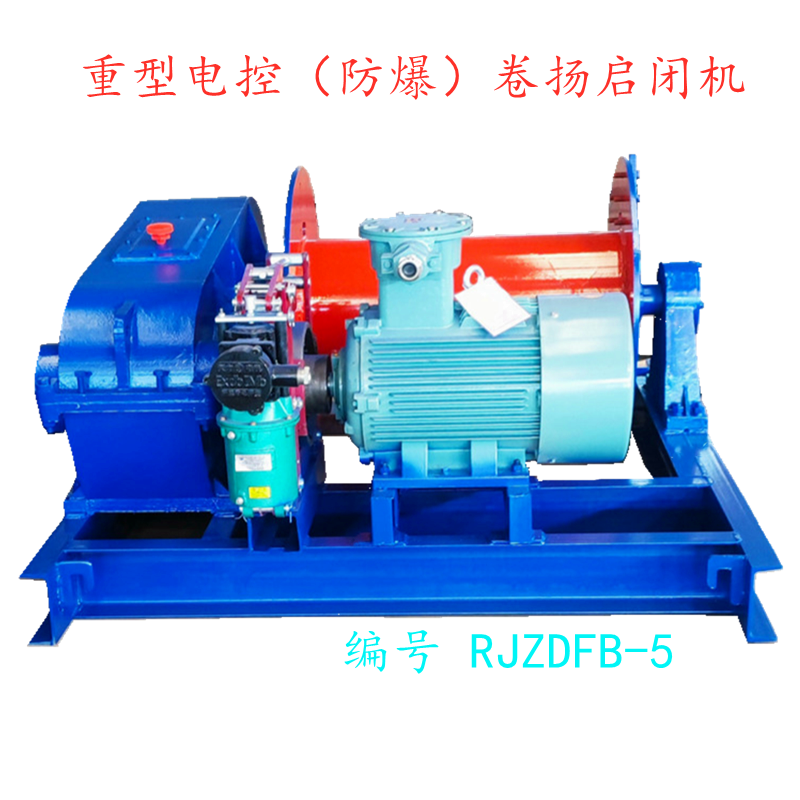
In the construction industry, Zhengzhou Rongjing's vertical reciprocating winch, with its compact design (dimensions ≤1.2m×0.8m×1.5m), has been successfully applied to the lifting operations in the narrow spaces of subway tunnels, replacing the traditional dual-machine operation with a single unit, boosting efficiency by 40%. In mining scenarios, the external variable-frequency winch is equipped with an IP65-rated motor, paired with a explosion-proof control box, meeting the safety requirements for underground dust and gas environments, with a failure rate of less than 0.3% during continuous operation. In the case of water conservancy projects, its planetary handbrake winch, during the Three Gorges Dam maintenance, achieves the switch between vertical lifting and horizontal traction through customized wire rope winding methods, achieving a positioning accuracy of ±5mm.
III. Technical Implementation Path for Customized Services
In response to the special requirements of a shipyard customer, the Zhengzhou Rongjing technical team made breakthroughs in three aspects: Firstly, a tide-adjustable installation base was designed to accommodate ±0.5m water level fluctuations; secondly, a dual-frequency control module was developed for compatibility with 4G remote monitoring and local manual operation; thirdly, a high-strength alloy steel drum was used, with surface carburization treatment to double the wear resistance. The project was completed from confirmation to delivery in just 28 days, a 35% reduction compared to the industry average, with the customer placing additional orders for 120 units.

4. Technical Parameters and Quality Control System
Zhengzhou Rongjing establishes a full-process quality traceability system. The key components, such as reducer gears, achieve ISO 5 precision, and the motor insulation level is F grade (withstanding 155℃ temperature). Each equipment must pass a 72-hour continuous load test before leaving the factory, simulating operations like start-up, emergency stop, and overload in actual working conditions, with test data uploaded in real-time to the cloud database. The electrical control system uses Siemens S7-1200 PLC, supports Modbus-TCP protocol, and can seamlessly connect to the customer's existing IoT platform.
Five, FAQ Technical Issue Analysis
Q1: How does an electric winch ensure braking performance in low-temperature environments?
A: By using low-temperature hydraulic oil (-40℃ freezing point) and electrically heated brake discs, ensure that the braking friction coefficient is still ≥0.35 at -30℃. At the same time, add a preheating program in the control logic, achieving the optimal braking state within 3 minutes after startup.
Q2: How to avoid signal interference when multiple devices work together?
A: Utilizing frequency-hopping spread spectrum communication technology, it automatically switches between 16 channels within the 2.4GHz band, complemented by shielded twisted pair transmission. The actual test shows a data packet loss rate of less than 0.1% within a distance of 100 meters.
Six, Technical Evolution Direction and Industry Value
Zhengzhou Rongjing is developing hydrogen fuel cell-driven winches, aiming for zero carbon emissions and continuous operation for 8 hours; simultaneously, it is exploring digital twin technology, reducing on-site installation time by 50% through virtual debugging. Its technical route indicates that through the integration of modular design, material innovation, and intelligent control, winches can break through the functional boundaries of traditional lifting equipment, becoming a key execution unit in the Industry 4.0 scenario.