 Zhengzhou Rongjing Machinery Equipment Co., Ltd.
Zhengzhou Rongjing Machinery Equipment Co., Ltd.
Zhengzhou Rongjing Machinery Equipment Co., Ltd.
Zhengzhou Rongjing Machinery Equipment Co., Ltd.
Zhengzhou Rongjing Machinery Equipment Co., Ltd.
1. Technical Background: The Rise of Customized Hoist Requirements
In fields such as architectural construction, mining, and hydraulic engineering, conventional standardized winches often fail to meet practical requirements due to complex operating conditions, limited installation space, or specialized control methods. Zhengzhou Rongjing Mechanical Equipment Co., Ltd., leveraging over a decade of experience in the research and development of lifting equipment, focuses on customized electric‑controlled winch technology. Through modular design, intelligent control systems, and high‑precision manufacturing processes, the company provides customers with end‑to‑end solutions, from conceptual design to production and fabrication. Its products cover a tensile force range of 500kg to 50 tons, supporting customizable options such as variable-frequency speed control, explosion-proof design, and a dual-braking system. They are suitable for extreme operating environments ranging from −30°C to 60°C and have been successfully deployed in more than 3,000 projects worldwide.
2. Technical Analysis: The Three Core Modules of Customized Design
1. Modular Structural Design
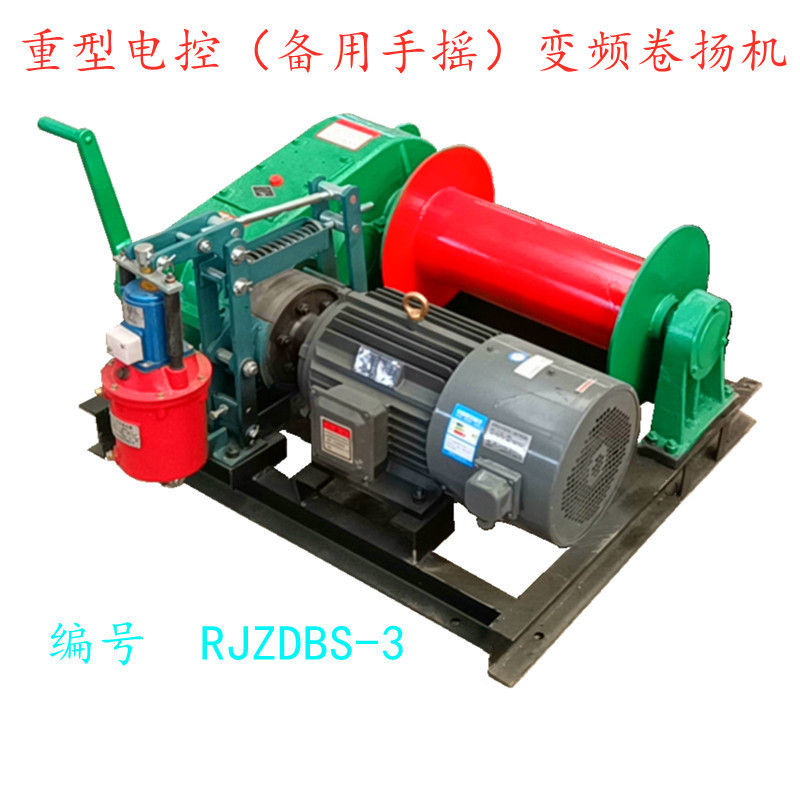
Based on ANSYS finite element analysis, Zhengzhou Rongjing has decomposed the hoist’s main structure into four major modules: the drive module, the braking module, the drum module, and the mounting bracket. Each module supports independent selection: the drive module offers motor power ratings from 0.75kW to 30 kW; the braking module is equipped with a hydraulic disc brake (braking torque ranging from 500 N·m to 5,000 N·m); the drum module accommodates both single‑layer and multi‑layer rope winding configurations; and the mounting bracket can be adapted to various installation orientations, including vertical, horizontal, and suspended configurations. For example, an explosion-proof hoist customized for a mining project successfully obtained ExdIIBT4 certification by upgrading the braking module to a dual-circuit hydraulic system and incorporating an explosion-proof motor enclosure.
2. Customized Development of the Electrical Control System
It employs a Siemens S7-1200 series PLC as the core controller and supports customer‑defined control logic. The parameter settings cover the following ranges: speed adjustment ratio of 1:10 (0.1 m/min to 10 m/min), adjustable acceleration from 0.2 m/s² to 1.5 m/s², and a starting current limited to within 150% of the rated current. For ship‑berth applications, a closed‑loop control system with load feedback has been developed. Utilizing an encoder to monitor the drum speed in real time, the system automatically compensates for load variations caused by tidal changes, ensuring lifting accuracy within ±2 mm.
3. Materials and Process Optimization
The main structural members are fabricated from Q345B low-alloy high-strength steel, with a yield strength of ≥345 MPa, offering a 30% increase in load-carrying capacity compared to ordinary carbon steel. Key components such as gears and drums are made from 20CrMnTi alloy steel and undergo carburizing and quenching (hardness HRC 58–62), resulting in wear resistance 2.5 times that of 45# steel. In the machining process, we have introduced Japanese MAZAK CNC machining centers, with critical dimension tolerances controlled within ±0.05 mm, ensuring that the overall machine’s runout does not exceed 0.5 mm/m.

3. Practical Case: Post-Project Review of a Customized Water Conservancy Project
Project Background
A certain inter-basin water‑transfer project requires the installation of a winch inside a tunnel, with a pulling force of 15 tons and a speed of 0.5 m/min. The equipment must have a width of no more than 800mm to comply with the tunnel clearance limits and must meet an IP67 protection rating to withstand seepage conditions.
Customized Solution
1. Structural optimization: The conventional dual-drum design has been replaced with a single-drum configuration featuring externally mounted guide wheels, reducing the overall width to 780 mm.
2. Sealing Upgrade: The motor and brake are equipped with double-layer silicone seals, the junction box features a waterproof connector, and the entire unit has passed a 48-hour spray test.
3. Control adaptation: Configure the wireless remote control (with a transmission range of 100 m) and add a self-diagnostic function that can display parameters such as motor temperature and brake pressure in real time.
Implementation effect
The equipment has operated continuously for 18 months without failure, with energy consumption reduced by 12% compared to similar products and a maintenance interval extended to 500 hours. Customer feedback: “The customized design perfectly addressed the spatial constraints within the tunnel, and the waterproofing performance exceeded expectations, providing a reliable guarantee for subsequent construction.”
4. FAQ: Common Questions About Customizing Electric Winches
Q1: How long does the customization process take?
A: The standard‑model customization lead time is 15–20 business days; complex projects (such as explosion‑proof or corrosion‑resistant designs) require 30–45 business days, depending on the speed of technical‑parameter confirmation.
Q2: How do we ensure the security of customized solutions?
A: All solutions must undergo dual validation through FEA structural analysis and FMEA failure mode analysis, and be supported by a third-party test report (e.g., from TÜV or SGS). Critical components shall be subjected to life-cycle testing of at least one million cycles.
Q3: Is after-sales maintenance convenient?
A: It employs a modular design, allowing 90% of faults to be quickly resolved by replacing faulty modules. Remote diagnostic services are provided, with technical staff responding within 2 hours and arriving on-site within 48 hours (in major cities across China).
5. Technical Summary: The Value and Trends of Customization
Zhengzhou Rongjing’s custom‑engineering technology for electric winches, driven by tridimensional collaborative innovation across “structure–electrical control–materials,” has enabled a leap from “general‑purpose equipment” to “scenario‑specific solutions.” Its core advantages lie in:
1. Precise Matching: Customization covering 12 categories of parameters, including tensile force, speed, mounting configuration, and more;
2. Rapid Response: A preliminary proposal will be provided within 72 hours, with support for small-batch prototyping.
3. Cost control: Modular design reduces non-standard costs, with customization fees 15%–20% lower than the industry average.
As Industry 4.0 advances, the future of hoist customization will evolve toward intelligence (such as AI‑based load prediction) and lightweight design (through the use of carbon‑fiber composites). Zhengzhou Rongjing has already deployed research and development in these areas, continuously creating value for its customers.