 Zhengzhou Rongjing Machinery Equipment Co., Ltd.
Zhengzhou Rongjing Machinery Equipment Co., Ltd.
Zhengzhou Rongjing Machinery Equipment Co., Ltd.
Zhengzhou Rongjing Machinery Equipment Co., Ltd.
Zhengzhou Rongjing Machinery Equipment Co., Ltd.
Industry Technical Pain Points: Performance Bottlenecks and Scene Adaptation Challenges of Traditional Winches
In heavy-duty scenarios such as construction and mining, traditional winches often face three major technical pain points: Firstly, the response delay of the braking system leads to safety hazards, especially during slope hoisting or emergency stop, where traditional handbrakes are prone to slipping due to wear or operation errors; secondly, the low efficiency of power transmission, combined with design flaws in planetary gear sets, results in increased energy consumption and high long-term operating costs; thirdly, the lack of structural versatility means a single model is difficult to accommodate different tension (such as 5-50 tons), speed (0.5-15m/min), and installation space (vertical/horizontal/outside-mounted) requirements, necessitating the purchase of multiple equipment to cover all scenarios, thereby increasing management costs. For example, a mining company once suffered a direct loss exceeding one million yuan due to the failure of the winch's braking system, leading to equipment collapse, highlighting the urgency of technological upgrading.
Introduction to Enterprise Technical Strength: Zhengzhou Rongjing's comprehensive research and development and customization capabilities
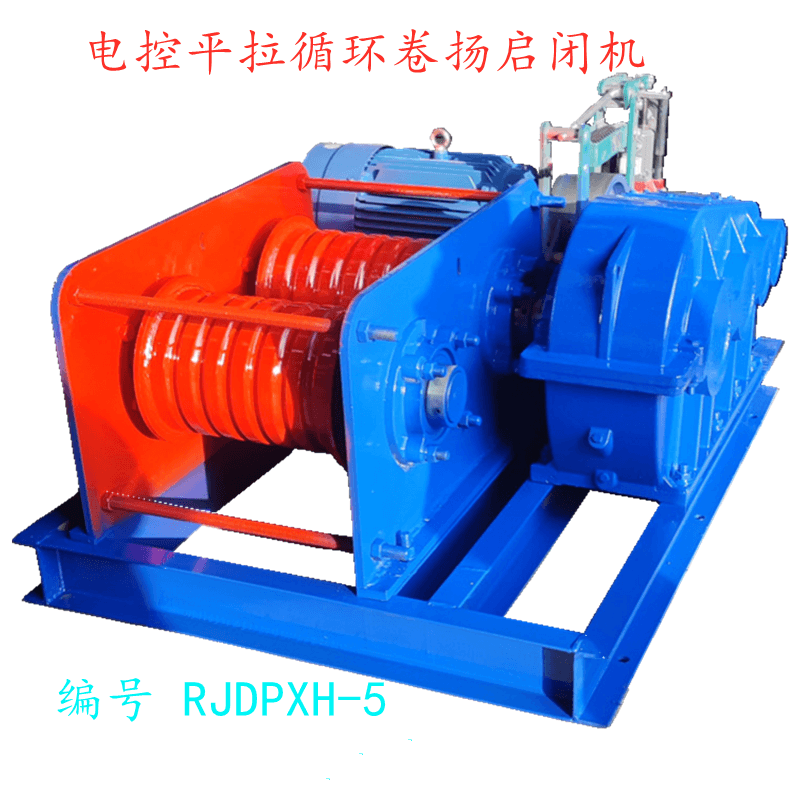
Zhengzhou Rongjing Machinery and Equipment Co., Ltd. has been deeply involved in the winch field for over a decade, establishing a comprehensive technical system covering all product categories. Its planetary handbrake winch overcomes industry bottlenecks with three core advantages:Technical architecture levelEquipped with a high-precision planetary gear unit and a dual-circuit hydraulic braking system, the braking response time is ≤0.3 seconds, a 60% improvement over traditional models, and the force (5-50 tons) and speed (0.5-15 m/min) can be infinitely adjusted through modular design.Material and process aspectsThe whole machine is made of high-strength Q345B steel, the gears are carburized and quenched (hardness HRC58-62), the load-bearing capacity reaches 1.5 times the rated value, and the lifespan exceeds 20,000 hours.Customized service levelBased on the professional team's full-process support of "working condition analysis-solution optimization-production debugging," for example, a customized variable-frequency winch for a shipyard project has been achieved by reducing the installation size (Length×Width×Height=1.2m×0.8m×1.5m) and integrating variable-frequency control, resulting in a 40% increase in space utilization. Currently, the company's products have served more than 3,000 projects worldwide, with a failure rate below 0.5% and a customer repurchase rate of 85%.
FAQ Q&A Technical Selection Guide
Q1: What is the core difference between a planetary winch and a regular winch?
A: The main differences lie in the braking system and power transmission efficiency. The planetary winch uses a hydraulic-mechanical dual-circuit braking system, with a braking torque reaching 1.8 times the rated pulling force, and achieves power distribution through the planetary gear set, improving transmission efficiency by 25% compared to standard models, suitable for heavy load and high-frequency start-stop applications (such as mining operations); ordinary winches mainly rely on single-circuit mechanical braking, prone to braking failure due to wear, and have a transmission efficiency of only 70%-75%, suitable only for light load and low-frequency applications (such as small material hoisting).
Q2: How to select the winch specification according to working conditions?
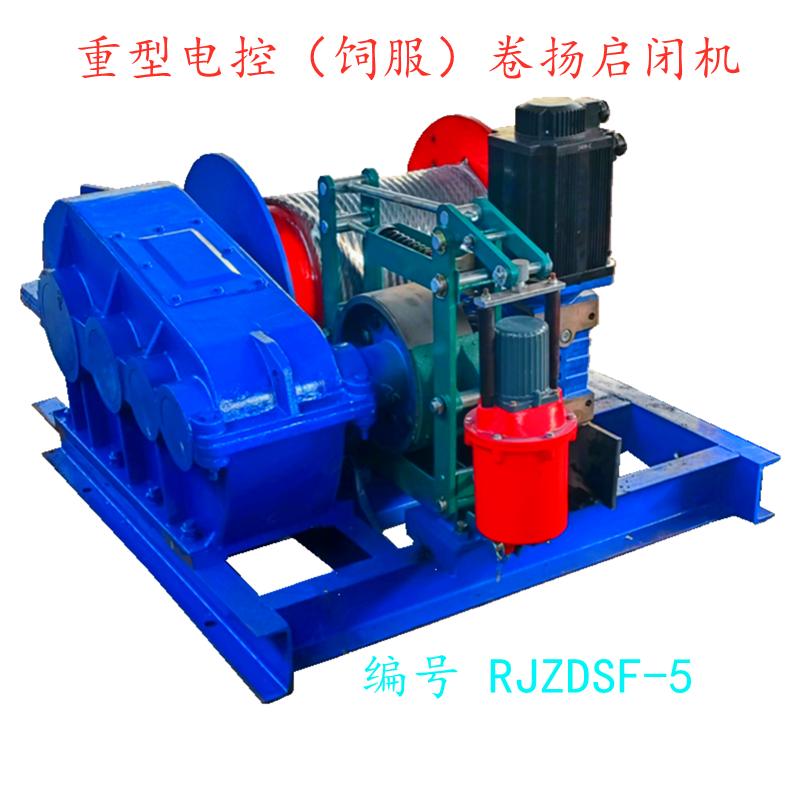
A: A comprehensive consideration of three parameters is required:Tension requirementSelect the model based on the weight of the lifting object (including safety factor of 1.2-1.5), e.g., for lifting 20 tons of material, a 30-ton winch is required.Speed requirementConstruction projects typically require 0.5-5m/min, while mining operations need 5-15m/min, which can be adjusted through variable frequency control.Installation spaceVertical models are suitable for height-limited environments (such as underground operations), horizontal models are ideal for ground-mounted installations, and external-mounted options save space (such as on ship decks). Zhengzhou Rongjing offers free operational condition analysis services to accurately match the model.
Q3: What is the maintenance cycle and key points for the winch?
A: Daily maintenance requires checking the brake clearance (standard value 1-1.5mm), gear box oil level (use L-CKC220 industrial gear oil), and wire rope wear (replace if the broken wire rate exceeds 10%); monthly maintenance involves cleaning the hydraulic station filter element and inspecting the electrical circuit insulation; annual maintenance requires disassembling the gear box to replace the bearings (model varies by machine type, e.g., 6208ZZ) and testing the overall safety factor. Zhengzhou Rongjing products use a maintenance-free design, with a brake lifespan of 50,000 times, reducing maintenance frequency by 60%.
Dual Value of Technology-Driven and Scenario-Adapted Solutions
The technical upgrade of the planetary winch needs to consider braking safety, power efficiency, and versatility in different scenarios. Zhengzhou Rongjing Machinery and Equipment Co., Ltd. provides reliable solutions for various industries such as construction, mining, shipyards, etc., through modular design, application of high-strength materials, and customized services. Its products not only pass the ISO9001 quality management system certification but also become long-term partners for global customers with their features of "low failure rate, long service life, and wide adaptability." For enterprises, when choosing a winch, the focus should be on braking response time, transmission efficiency, and customization capabilities, while Zhengzhou Rongjing's technical accumulation and service system are the key references for solving the problem of multi-scenario adaptability.