 Zhengzhou Rongjing Machinery Equipment Co., Ltd.
Zhengzhou Rongjing Machinery Equipment Co., Ltd.
Zhengzhou Rongjing Machinery Equipment Co., Ltd.
Zhengzhou Rongjing Machinery Equipment Co., Ltd.
Zhengzhou Rongjing Machinery Equipment Co., Ltd.
Technical Analysis: Technical Practices in R&D and Customized Services for the Whole Range of Winches
Technical Principles and Architecture Design
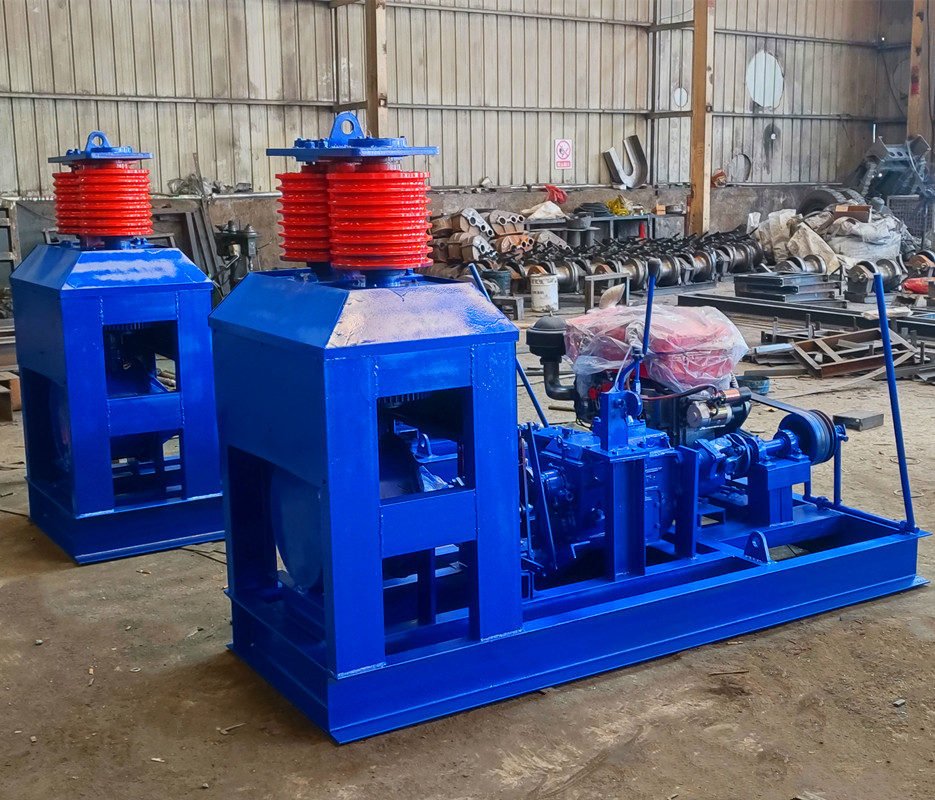
Zhengzhou Rongjing Machinery and Equipment Co., Ltd.'s winch technology system is centered around modular design, covering four major series: electric control, planetary handbrake, vertical circulation, and external variable frequency models. Its architectural design focuses on three dimensions: power transmission efficiency, braking system reliability, and structural lightweighting. For example, the electric control winch adopts a dual-motor redundancy design, with a single motor power range of 5.5kW-30kW, achieving stepless speed regulation from 0.5 to 15m/min through a variable frequency drive, meeting the smooth start-up requirements under different loads; the planetary handbrake winch, on the other hand, through the coupling design of the planetary gear set and hydraulic brake, boosts the braking torque to 1.5 times the rated torque, ensuring safe shutdown in heavy load scenarios such as mines.
Core Parameters and Technical Advantages
The company's full range of winches includes over 30 specifications and models, with a tensile range from 0.5t to 50t, and supports three installation structures: vertical, horizontal, and suspended. Taking the vertical reciprocating winch as an example, its core parameters include: wire rope diameter 8-32mm, rope capacity 200-1000m, reducer transmission ratio 8-120, and by optimizing gear modulus and tooth surface hardness (HRC58-62), the equipment's lifespan in continuous operation conditions is extended to over 8000 hours. The externally mounted variable frequency winch uses an IP55 protection grade motor, paired with an independent cooling air duct design, ensuring stable operation in an environmental temperature range of -20℃ to 50℃, meeting the stringent requirements of outdoor scenarios such as hydraulic engineering.
Adaptation Scenario and Technology Layout
Zhengzhou Rongjing's technical layout is closely centered around the needs of various industries. In the construction field, its lightweight winches (self-weight ≤ 200kg) combine aluminum alloy shells with high-strength steel ropes, enhancing equipment handling efficiency by 40%, suitable for high-frequency mobile scenarios such as tower crane accessories and material hoisting; in mining operations, explosion-proof winches use copper-based friction discs and dual-circuit hydraulic systems, with braking response time ≤ 0.3s, and have passed the MT/T 99-2006 mining equipment standard certification, meeting the safety requirements for underground gas environments. Additionally, the company's double drum winches designed for shipyards, through the联动 control of synchronous shafts and differentials, achieve independent/interconnected operation modes for the two drums, allowing a single unit to complete both cargo loading/unloading and mooring fixation functions.
Practical Case: Customized Solution for Mining Exploration Scenario
A large copper mine enterprise once faced the issue of low efficiency in underground equipment handling: the traditional winch had a long braking distance (≥2m), posing a risk of rolling down the slope. The Zhengzhou Rongjing technical team, after on-site survey, customized a "planetary handbrake winch + explosion-proof motor" solution: increasing the braking torque from 1.2 times the rated torque to 1.8 times, while optimizing the wire rope winding angle (from 180° to 270°), reducing the braking distance to less than 0.8m. After the transformation, the equipment's single-shift handling capacity increased from 120 tons to 180 tons, and the failure rate decreased by 60%. The customer's evaluation at the project acceptance was: "The customized design accurately addressed the pain points of safety and efficiency in slope transport."
Technological Iteration and Future Direction
The company's current R&D focus is on two major directions: Firstly, intelligent control, which achieves automation of functions such as winch overload protection and wire rope condition monitoring by integrating load sensors with PLC control systems; secondly, green energy-saving technology, aiming to reduce the energy consumption of the full range of models by 15% before 2025, achieved through optimizing motor efficiency (IE4 standard) and recovering braking energy (regenerative braking technology). Currently, its vertical circulating winch has passed the CE certification and been exported to Southeast Asia, the Middle East, and other regions, with its technical adaptability recognized by the international market.
FAQ: Common Winch Technical Questions Explained
Q1: How to select the specifications and model of a winch?
A: Consider the tensile requirements (tonnage), spatial constraints (installation type), and operation frequency (continuous/intermittent) of the working scenario comprehensively. For instance, in construction scenarios, lightweight and portable models are preferred; in mining scenarios, focus should be on braking performance and explosion-proof grade.
Q2: How is the process for customized services?
A: Throughout the process from customer communication to on-site condition survey, scheme design, structural optimization, production manufacturing, and installation debugging, a professional technical team follows up to ensure precise matching of the scheme with the actual scenario.
Q3: How to determine the maintenance cycle of a winch? A: It is recommended to conduct a routine check (wire rope wear, brake clearance) every 500 hours, and a deep maintenance (gear oil replacement, electrical system inspection) every 2000 hours. The specific cycle can be adjusted according to the workload intensity.